Vulnerability Scan Result

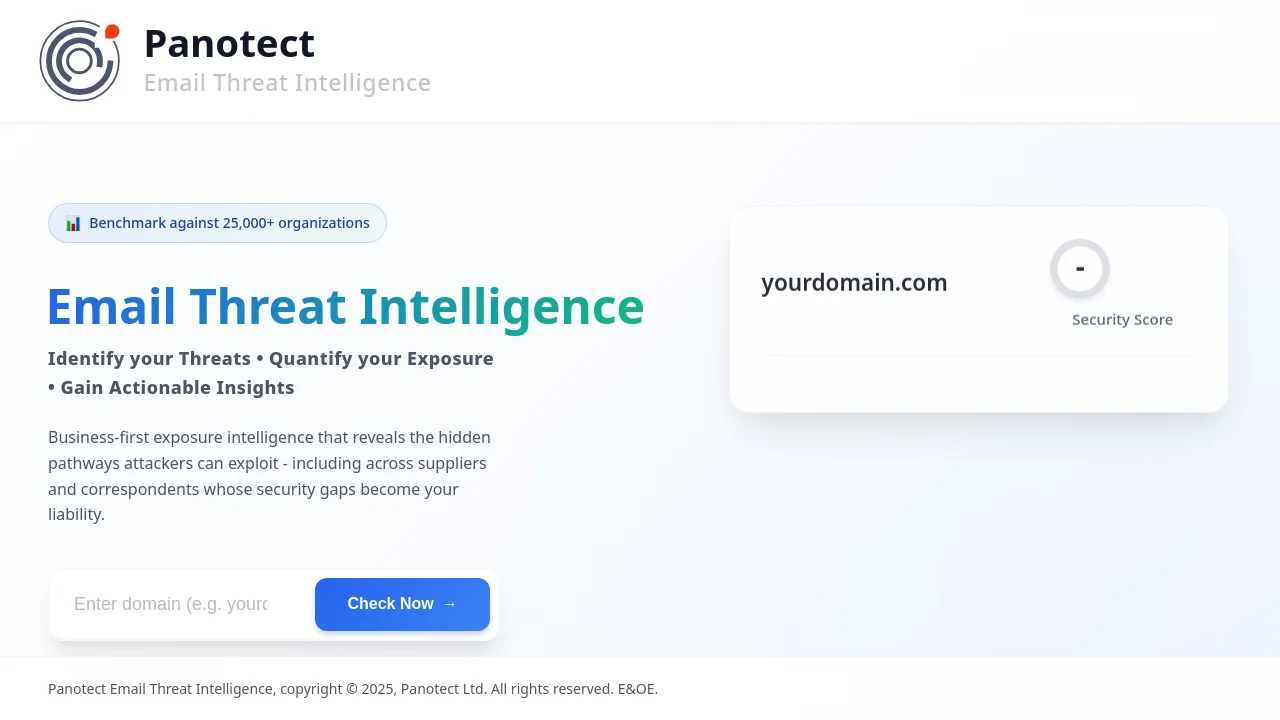
| Title: | Panotect - Email Threat Intelligence |
| Description: | Protect your organization with email threat intelligence designed for executive decision-making |
| ip_address | 188.40.192.61 |
| country | DE  |
| network_name | Hetzner Online GmbH |
| asn | AS24940 |
80/tcp | http | nginx 1.22.1 |
443/tcp | https | nginx 1.22.1 |
3000/tcp | http | - - |
8000/tcp | http | uvicorn - |
| Software / Version | Category |
|---|---|
| Next.js 14.2.5 | JavaScript frameworks, Web frameworks, Web servers, Static site generator |
| Next.js App Router | JavaScript frameworks, Web servers |
| Nginx 1.22.1 | Web servers, Reverse proxies |
| React | JavaScript frameworks |
| Webpack | Miscellaneous |
| Priority Hints | Performance |
| HSTS | Security |
Web Application Vulnerabilities
Evidence
| CVE | CVSS | EPSS Score | EPSS Percentile | Summary |
|---|---|---|---|---|
| CVE-2025-29927 | 9.1 | 0.92955 | 0.99777 | Next.js is a React framework for building full-stack web applications. Starting in version 1.11.4 and prior to versions 12.3.5, 13.5.9, 14.2.25, and 15.2.3, it is possible to bypass authorization checks within a Next.js application, if the authorization check occurs in middleware. If patching to a safe version is infeasible, it is recommend that you prevent external user requests which contain the x-middleware-subrequest header from reaching your Next.js application. This vulnerability is fixed in 12.3.5, 13.5.9, 14.2.25, and 15.2.3. |
| CVE-2025-67779 | 7.5 | 0.00378 | 0.59393 | It was found that the fix addressing CVE-2025-55184 in React Server Components was incomplete and does not prevent a denial of service attack in a specific case. React Server Components versions 19.0.2, 19.1.3 and 19.2.2 are affected, allowing unsafe deserialization of payloads from HTTP requests to Server Function endpoints. This can cause an infinite loop that hangs the server process and may prevent future HTTP requests from being served. |
| CVE-2025-55184 | 7.5 | 0.26234 | 0.9631 | A pre-authentication denial of service vulnerability exists in React Server Components versions 19.0.0, 19.0.1 19.1.0, 19.1.1, 19.1.2, 19.2.0 and 19.2.1, including the following packages: react-server-dom-parcel, react-server-dom-turbopack, and react-server-dom-webpack. The vulnerable code unsafely deserializes payloads from HTTP requests to Server Function endpoints, which can cause an infinite loop that hangs the server process and may prevent future HTTP requests from being served. |
| CVE-2024-51479 | 7.5 | 0.66731 | 0.98548 | Next.js is a React framework for building full-stack web applications. In affected versions if a Next.js application is performing authorization in middleware based on pathname, it was possible for this authorization to be bypassed for pages directly under the application's root directory. For example: * [Not affected] `https://example.com/` * [Affected] `https://example.com/foo` * [Not affected] `https://example.com/foo/bar`. This issue is patched in Next.js `14.2.15` and later. If your Next.js application is hosted on Vercel, this vulnerability has been automatically mitigated, regardless of Next.js version. There are no official workarounds for this vulnerability. |
| CVE-2024-46982 | 7.5 | 0.49062 | 0.97781 | Next.js is a React framework for building full-stack web applications. By sending a crafted HTTP request, it is possible to poison the cache of a non-dynamic server-side rendered route in the pages router (this does not affect the app router). When this crafted request is sent it could coerce Next.js to cache a route that is meant to not be cached and send a `Cache-Control: s-maxage=1, stale-while-revalidate` header which some upstream CDNs may cache as well. To be potentially affected all of the following must apply: 1. Next.js between 13.5.1 and 14.2.9, 2. Using pages router, & 3. Using non-dynamic server-side rendered routes e.g. `pages/dashboard.tsx` not `pages/blog/[slug].tsx`. This vulnerability was resolved in Next.js v13.5.7, v14.2.10, and later. We recommend upgrading regardless of whether you can reproduce the issue or not. There are no official or recommended workarounds for this issue, we recommend that users patch to a safe version. |
Vulnerability description
Outdated or vulnerable software components include versions of server-side software that are no longer supported or have known, publicly disclosed vulnerabilities. Using outdated software significantly increases the attack surface of a system and may allow unauthorized access, data leaks, or service disruptions. Vulnerabilities in these components are often well-documented and actively exploited by attackers. Without security patches or vendor support, any weaknesses remain unmitigated, exposing the application to risks. In some cases, even after patching, the reported version may remain unchanged, requiring manual verification.
Risk description
The risk is that an attacker could search for an appropriate exploit (or create one himself) for any of these vulnerabilities and use it to attack the system. Since the vulnerabilities were discovered using only version-based testing, the risk level for this finding will not exceed 'high' severity. Critical risks will be assigned to vulnerabilities identified through accurate active testing methods.
Recommendation
In order to eliminate the risk of these vulnerabilities, we recommend you check the installed software version and upgrade to the latest version.
Classification
| CWE | CWE-1035 |
| OWASP Top 10 - 2017 | |
| OWASP Top 10 - 2021 |
Evidence
| CVE | CVSS | EPSS Score | EPSS Percentile | Summary |
|---|---|---|---|---|
| CVE-2025-23419 | 5.3 | 0.0383 | 0.88169 | When multiple server blocks are configured to share the same IP address and port, an attacker can use session resumption to bypass client certificate authentication requirements on these servers. This vulnerability arises when TLS Session Tickets https://nginx.org/en/docs/http/ngx_http_ssl_module.html#ssl_session_ticket_key are used and/or the SSL session cache https://nginx.org/en/docs/http/ngx_http_ssl_module.html#ssl_session_cache are used in the default server and the default server is performing client certificate authentication. Note: Software versions which have reached End of Technical Support (EoTS) are not evaluated. |
Vulnerability description
Outdated or vulnerable software components include versions of server-side software that are no longer supported or have known, publicly disclosed vulnerabilities. Using outdated software significantly increases the attack surface of a system and may allow unauthorized access, data leaks, or service disruptions. Vulnerabilities in these components are often well-documented and actively exploited by attackers. Without security patches or vendor support, any weaknesses remain unmitigated, exposing the application to risks. In some cases, even after patching, the reported version may remain unchanged, requiring manual verification.
Risk description
The risk is that an attacker could search for an appropriate exploit (or create one himself) for any of these vulnerabilities and use it to attack the system. Since the vulnerabilities were discovered using only version-based testing, the risk level for this finding will not exceed 'high' severity. Critical risks will be assigned to vulnerabilities identified through accurate active testing methods.
Recommendation
In order to eliminate the risk of these vulnerabilities, we recommend you check the installed software version and upgrade to the latest version.
Classification
| CWE | CWE-1035 |
| OWASP Top 10 - 2017 | |
| OWASP Top 10 - 2021 |
Evidence
| URL | Evidence |
|---|---|
| https://checkemailsecurity.com/ | Response does not include the HTTP Content-Security-Policy security header or meta tag |
Vulnerability description
We noticed that the target application lacks the Content-Security-Policy (CSP) header in its HTTP responses. The CSP header is a security measure that instructs web browsers to enforce specific security rules, effectively preventing the exploitation of Cross-Site Scripting (XSS) vulnerabilities.
Risk description
The risk is that if the target application is vulnerable to XSS, lack of this header makes it easily exploitable by attackers.
Recommendation
Configure the Content-Security-Header to be sent with each HTTP response in order to apply the specific policies needed by the application.
Classification
| CWE | CWE-1021 |
| OWASP Top 10 - 2017 | |
| OWASP Top 10 - 2021 |
Evidence
| Software / Version | Category |
|---|---|
| Next.js 14.2.5 | JavaScript frameworks, Web frameworks, Web servers, Static site generator |
| Next.js App Router | JavaScript frameworks, Web servers |
| Nginx 1.22.1 | Web servers, Reverse proxies |
| React | JavaScript frameworks |
| Webpack | Miscellaneous |
| Priority Hints | Performance |
| HSTS | Security |
Vulnerability description
We noticed that server software and technology details are exposed, potentially aiding attackers in tailoring specific exploits against identified systems and versions.
Risk description
The risk is that an attacker could use this information to mount specific attacks against the identified software type and version.
Recommendation
We recommend you to eliminate the information which permits the identification of software platform, technology, server and operating system: HTTP server headers, HTML meta information, etc.
Classification
| CWE | CWE-200 |
| OWASP Top 10 - 2017 | |
| OWASP Top 10 - 2021 |
Evidence
| URL | Method | Summary |
|---|---|---|
| https://checkemailsecurity.com/ | OPTIONS | We did a HTTP OPTIONS request. The server responded with a 405 status code and the header: `Allow: GET, HEAD` Request / Response |
Vulnerability description
We have noticed that the webserver responded with an Allow HTTP header when an OPTIONS HTTP request was sent. This method responds to requests by providing information about the methods available for the target resource.
Risk description
The only risk this might present nowadays is revealing debug HTTP methods that can be used on the server. This can present a danger if any of those methods can lead to sensitive information, like authentication information, secret keys.
Recommendation
We recommend that you check for unused HTTP methods or even better, disable the OPTIONS method. This can be done using your webserver configuration.
Classification
| CWE | CWE-16 |
| OWASP Top 10 - 2017 | |
| OWASP Top 10 - 2021 |
Vulnerability description
We have noticed that the server is missing the security.txt file, which is considered a good practice for web security. It provides a standardized way for security researchers and the public to report security vulnerabilities or concerns by outlining the preferred method of contact and reporting procedures.
Risk description
There is no particular risk in not having a security.txt file for your server. However, this file is important because it offers a designated channel for reporting vulnerabilities and security issues.
Recommendation
We recommend you to implement the security.txt file according to the standard, in order to allow researchers or users report any security issues they find, improving the defensive mechanisms of your server.
Classification
| CWE | CWE-1188 |
| OWASP Top 10 - 2017 | |
| OWASP Top 10 - 2021 |
Infrastructure Vulnerabilities
Evidence
| CVE | CVSS | EPSS Score | EPSS Percentile | CISA KEV | Summary |
|---|---|---|---|---|---|
| CVE-2025-23419 | 5.3 | 0.0383 | 0.88169 | No | When multiple server blocks are configured to share the same IP address and port, an attacker can use session resumption to bypass client certificate authentication requirements on these servers. This vulnerability arises when TLS Session Tickets https://nginx.org/en/docs/http/ngx_http_ssl_module.html#ssl_session_ticket_key are used and/or the SSL session cache https://nginx.org/en/docs/http/ngx_http_ssl_module.html#ssl_session_cache are used in the default server and the default server is performing client certificate authentication. Note: Software versions which have reached End of Technical Support (EoTS) are not evaluated. |
Vulnerability description
Vulnerabilities found for Nginx 1.22.1
Risk description
These vulnerabilities expose the affected applications to the risk of unauthorized access to confidential data and possibly to denial of service attacks. An attacker could search for an appropriate exploit (or create one) for any of these vulnerabilities and use it to attack the system. Notes: - The vulnerabilities are identified based on the server's version.; - Only the first 5 vulnerabilities with the highest risk are shown for each port.; Since the vulnerabilities were discovered using only version-based testing, the risk level for this finding will not exceed "high" severity. Critical risks will be assigned to vulnerabilities identified through accurate active testing methods.
Recommendation
We recommend you to upgrade the affected software to the latest version in order to eliminate the risks imposed by these vulnerabilities.
Evidence
| CVE | CVSS | EPSS Score | EPSS Percentile | CISA KEV | Summary |
|---|---|---|---|---|---|
| CVE-2025-23419 | 5.3 | 0.0383 | 0.88169 | No | When multiple server blocks are configured to share the same IP address and port, an attacker can use session resumption to bypass client certificate authentication requirements on these servers. This vulnerability arises when TLS Session Tickets https://nginx.org/en/docs/http/ngx_http_ssl_module.html#ssl_session_ticket_key are used and/or the SSL session cache https://nginx.org/en/docs/http/ngx_http_ssl_module.html#ssl_session_cache are used in the default server and the default server is performing client certificate authentication. Note: Software versions which have reached End of Technical Support (EoTS) are not evaluated. |
Vulnerability description
Vulnerabilities found for Nginx 1.22.1
Risk description
These vulnerabilities expose the affected applications to the risk of unauthorized access to confidential data and possibly to denial of service attacks. An attacker could search for an appropriate exploit (or create one) for any of these vulnerabilities and use it to attack the system. Notes: - The vulnerabilities are identified based on the server's version.; - Only the first 5 vulnerabilities with the highest risk are shown for each port.; Since the vulnerabilities were discovered using only version-based testing, the risk level for this finding will not exceed "high" severity. Critical risks will be assigned to vulnerabilities identified through accurate active testing methods.
Recommendation
We recommend you to upgrade the affected software to the latest version in order to eliminate the risks imposed by these vulnerabilities.
Evidence
We found insecure DNS cookie usage on the following nameservers: gina.ns.cloudflare.com, fonzie.ns.cloudflare.com
Vulnerability description
We found that the server does not implement DNS Cookies or uses them insecurely. DNS Cookies help prevent DNS-based attacks, such as spoofing and amplification attacks.
Risk description
The risk exists because without DNS Cookies, the server is vulnerable to DNS spoofing and amplification attacks. Attackers can manipulate responses or use the server in distributed denial-of-service (DDoS) attacks, compromising network availability and security.
Recommendation
We recommend enabling DNS Cookies to prevent spoofed DNS responses. Ensure proper cookie validation is implemented to mitigate DNS amplification attacks. Regularly update DNS servers to support the latest DNS security features.
Evidence
We checked 2056 selectors but found no DKIM records.
Vulnerability description
We found that no DKIM record was configured. When a DKIM (DomainKeys Identified Mail) record is not present for a domain, it means that outgoing emails from that domain are not cryptographically signed. DKIM is a critical component of email authentication, allowing recipients to verify that an email was genuinely sent from an authorized server and that the message has not been altered in transit. The absence of a DKIM record leaves the domain vulnerable to email spoofing and phishing attacks, as attackers can send fraudulent emails that appear to originate from the domain without any cryptographic verification.
Risk description
Without a DKIM record, recipients have no way of verifying the integrity or authenticity of emails sent from the domain. This increases the likelihood of phishing and spoofing attacks, where malicious actors impersonate the domain to send fraudulent emails. This can lead to significant security incidents, such as credential theft, financial fraud, or the distribution of malware. Additionally, many email providers use DKIM as part of their spam and reputation filters, meaning that emails from a domain without DKIM may be flagged as spam or rejected, impacting the deliverability and reputation of legitimate emails.
Recommendation
We recommend implementing DKIM for your domain to enhance email security and protect your brand from email-based attacks. Generate a DKIM key pair (public and private keys), publish the public key in the DNS under the appropriate selector, and configure your email servers to sign outgoing messages using the private key. Ensure that the DKIM key length is at least 1024 bits to prevent cryptographic attacks. Regularly monitor DKIM signatures to ensure the system is functioning correctly and update keys periodically to maintain security.
Evidence
We managed to detect that nginx has reached the End-of-Life (EOL).
Version detected: 1.22.1 End-of-life date: 2023-04-11 Latest version for the cycle: 1.22.1 This release cycle (1.22) doesn't have long-term-support (LTS). The cycle was released on 2022-05-24 and its latest release date was 2022-10-19.
Risk description
Using end-of-life (EOL) software poses significant security risks for organizations. EOL software no longer receives updates, including critical security patches. This creates a vulnerability landscape where known and potentially new security flaws remain unaddressed, making the software an attractive target for malicious actors. Attackers can exploit these vulnerabilities to gain unauthorized access, disrupt services, or steal sensitive data. Moreover, without updates, compatibility issues arise with newer technologies, leading to operational inefficiencies and increased potential for system failures. Additionally, regulatory and compliance risks accompany the use of EOL software. Many industries have strict data protection regulations that require up-to-date software to ensure the highest security standards. Non-compliance can result in hefty fines and legal consequences. Organizations also risk damaging their reputation if a breach occurs due to outdated software, eroding customer trust and potentially leading to a loss of business. Therefore, continuing to use EOL software undermines both security posture and business integrity, necessitating timely upgrades and proactive risk management strategies.
Recommendation
To mitigate the risks associated with end-of-life (EOL) software, it's crucial to take proactive steps. Start by identifying any EOL software currently in use within your organization. Once identified, prioritize upgrading or replacing these applications with supported versions that receive regular updates and security patches. This not only helps close security gaps but also ensures better compatibility with newer technologies, enhancing overall system efficiency and reliability.Additionally, develop a comprehensive software lifecycle management plan. This plan should include regular audits to identify upcoming EOL dates and a schedule for timely updates or replacements. Train your IT staff and users about the importance of keeping software up to date and the risks associated with using outdated versions. By maintaining a proactive approach to software management, you can significantly reduce security risks, ensure compliance with industry regulations, and protect your organization's reputation and customer trust.
Evidence
We managed to detect that nginx has reached the End-of-Life (EOL).
Version detected: 1.22.1 End-of-life date: 2023-04-11 Latest version for the cycle: 1.22.1 This release cycle (1.22) doesn't have long-term-support (LTS). The cycle was released on 2022-05-24 and its latest release date was 2022-10-19.
Risk description
Using end-of-life (EOL) software poses significant security risks for organizations. EOL software no longer receives updates, including critical security patches. This creates a vulnerability landscape where known and potentially new security flaws remain unaddressed, making the software an attractive target for malicious actors. Attackers can exploit these vulnerabilities to gain unauthorized access, disrupt services, or steal sensitive data. Moreover, without updates, compatibility issues arise with newer technologies, leading to operational inefficiencies and increased potential for system failures. Additionally, regulatory and compliance risks accompany the use of EOL software. Many industries have strict data protection regulations that require up-to-date software to ensure the highest security standards. Non-compliance can result in hefty fines and legal consequences. Organizations also risk damaging their reputation if a breach occurs due to outdated software, eroding customer trust and potentially leading to a loss of business. Therefore, continuing to use EOL software undermines both security posture and business integrity, necessitating timely upgrades and proactive risk management strategies.
Recommendation
To mitigate the risks associated with end-of-life (EOL) software, it's crucial to take proactive steps. Start by identifying any EOL software currently in use within your organization. Once identified, prioritize upgrading or replacing these applications with supported versions that receive regular updates and security patches. This not only helps close security gaps but also ensures better compatibility with newer technologies, enhancing overall system efficiency and reliability.Additionally, develop a comprehensive software lifecycle management plan. This plan should include regular audits to identify upcoming EOL dates and a schedule for timely updates or replacements. Train your IT staff and users about the importance of keeping software up to date and the risks associated with using outdated versions. By maintaining a proactive approach to software management, you can significantly reduce security risks, ensure compliance with industry regulations, and protect your organization's reputation and customer trust.
Evidence
| Domain Queried | DNS Record Type | Description | Value |
|---|---|---|---|
| _dmarc.checkemailsecurity.com | TXT | Text record | "v=DMARC1; p=reject; sp=reject; pct=100; fo=1; adkim=s; aspf=s; rua=mailto:dmarc@checkemailsecurity.com; ruf=mailto:dmarc-fail@checkemailsecurity.com" |
Evidence
| Software / Version | Category |
|---|---|
| Next.js | JavaScript frameworks, Web frameworks, Web servers, Static site generator |
| Nginx 1.22.1 | Web servers, Reverse proxies |
| React | JavaScript frameworks |
| Webpack | Miscellaneous |
Vulnerability description
We noticed that server software and technology details are exposed, potentially aiding attackers in tailoring specific exploits against identified systems and versions.
Risk description
The risk is that an attacker could use this information to mount specific attacks against the identified software type and version.
Recommendation
We recommend you to eliminate the information which permits the identification of software platform, technology, server and operating system: HTTP server headers, HTML meta information, etc.
Evidence
| Software / Version | Category |
|---|---|
| Python | Programming languages |
| Uvicorn | Web servers |
Vulnerability description
We noticed that server software and technology details are exposed, potentially aiding attackers in tailoring specific exploits against identified systems and versions.
Risk description
The risk is that an attacker could use this information to mount specific attacks against the identified software type and version.
Recommendation
We recommend you to eliminate the information which permits the identification of software platform, technology, server and operating system: HTTP server headers, HTML meta information, etc.
Evidence
| Software / Version | Category |
|---|---|
| Next.js | JavaScript frameworks, Web frameworks, Web servers, Static site generator |
| React | JavaScript frameworks |
| Webpack | Miscellaneous |
Vulnerability description
We noticed that server software and technology details are exposed, potentially aiding attackers in tailoring specific exploits against identified systems and versions.
Risk description
The risk is that an attacker could use this information to mount specific attacks against the identified software type and version.
Recommendation
We recommend you to eliminate the information which permits the identification of software platform, technology, server and operating system: HTTP server headers, HTML meta information, etc.
Evidence
| Domain Queried | DNS Record Type | Description | Value |
|---|---|---|---|
| checkemailsecurity.com | A | IPv4 address | 188.40.192.61 |
| checkemailsecurity.com | NS | Name server | gina.ns.cloudflare.com |
| checkemailsecurity.com | NS | Name server | fonzie.ns.cloudflare.com |
| checkemailsecurity.com | MX | Mail server | 10 mail.mtight.com |
| checkemailsecurity.com | SOA | Start of Authority | fonzie.ns.cloudflare.com. dns.cloudflare.com. 2401936874 10000 2400 604800 1800 |
| checkemailsecurity.com | AAAA | IPv6 address | 2a01:4f8:110:13c5::61 |
| checkemailsecurity.com | SPF | Sender Policy Framework | "v=spf1 include:spf.mtight.com -all" |
| checkemailsecurity.com | CAA | Certificate Authority Authorization | 0 iodef "mailto:caa-violation@checkemailsecurity.com" |
| checkemailsecurity.com | CAA | Certificate Authority Authorization | 0 issue "comodoca.com" |
| checkemailsecurity.com | CAA | Certificate Authority Authorization | 0 issue "digicert.com; cansignhttpexchanges=yes" |
| checkemailsecurity.com | CAA | Certificate Authority Authorization | 0 issue "letsencrypt.org" |
| checkemailsecurity.com | CAA | Certificate Authority Authorization | 0 issue "pki.goog; cansignhttpexchanges=yes" |
| checkemailsecurity.com | CAA | Certificate Authority Authorization | 0 issue "ssl.com" |
| checkemailsecurity.com | CAA | Certificate Authority Authorization | 0 issuewild "comodoca.com" |
| checkemailsecurity.com | CAA | Certificate Authority Authorization | 0 issuewild "digicert.com; cansignhttpexchanges=yes" |
| checkemailsecurity.com | CAA | Certificate Authority Authorization | 0 issuewild "letsencrypt.org" |
| checkemailsecurity.com | CAA | Certificate Authority Authorization | 0 issuewild "pki.goog; cansignhttpexchanges=yes" |
| checkemailsecurity.com | CAA | Certificate Authority Authorization | 0 issuewild "ssl.com" |
| checkemailsecurity.com | CAA | Certificate Authority Authorization | 0 issuewild "www.digicert.com" |
| _dmarc.checkemailsecurity.com | TXT | Text record | "v=DMARC1; p=reject; sp=reject; pct=100; fo=1; adkim=s; aspf=s; rua=mailto:dmarc@checkemailsecurity.com; ruf=mailto:dmarc-fail@checkemailsecurity.com" |
Risk description
An initial step for an attacker aiming to learn about an organization involves conducting searches on its domain names to uncover DNS records associated with the organization. This strategy aims to amass comprehensive insights into the target domain, enabling the attacker to outline the organization's external digital landscape. This gathered intelligence may subsequently serve as a foundation for launching attacks, including those based on social engineering techniques. DNS records pointing to services or servers that are no longer in use can provide an attacker with an easy entry point into the network.
Recommendation
We recommend reviewing all DNS records associated with the domain and identifying and removing unused or obsolete records.
Evidence
| Operating System | Accuracy |
|---|---|
| Linux 5.0 - 5.4 | 100% |
Vulnerability description
OS Detection
Evidence
| Software / Version | Category |
|---|---|
| Next.js | JavaScript frameworks, Web frameworks, Web servers, Static site generator |
| Nginx 1.22.1 | Web servers, Reverse proxies |
| React | JavaScript frameworks |
| HSTS | Security |
| Webpack | Miscellaneous |
Vulnerability description
We noticed that server software and technology details are exposed, potentially aiding attackers in tailoring specific exploits against identified systems and versions.
Risk description
The risk is that an attacker could use this information to mount specific attacks against the identified software type and version.
Recommendation
We recommend you to eliminate the information which permits the identification of software platform, technology, server and operating system: HTTP server headers, HTML meta information, etc.
Evidence
| Domain Queried | DNS Record Type | Description | Value |
|---|---|---|---|
| checkemailsecurity.com | SPF | Sender Policy Framework | "v=spf1 include:spf.mtight.com -all" |