Vulnerability Scan Result

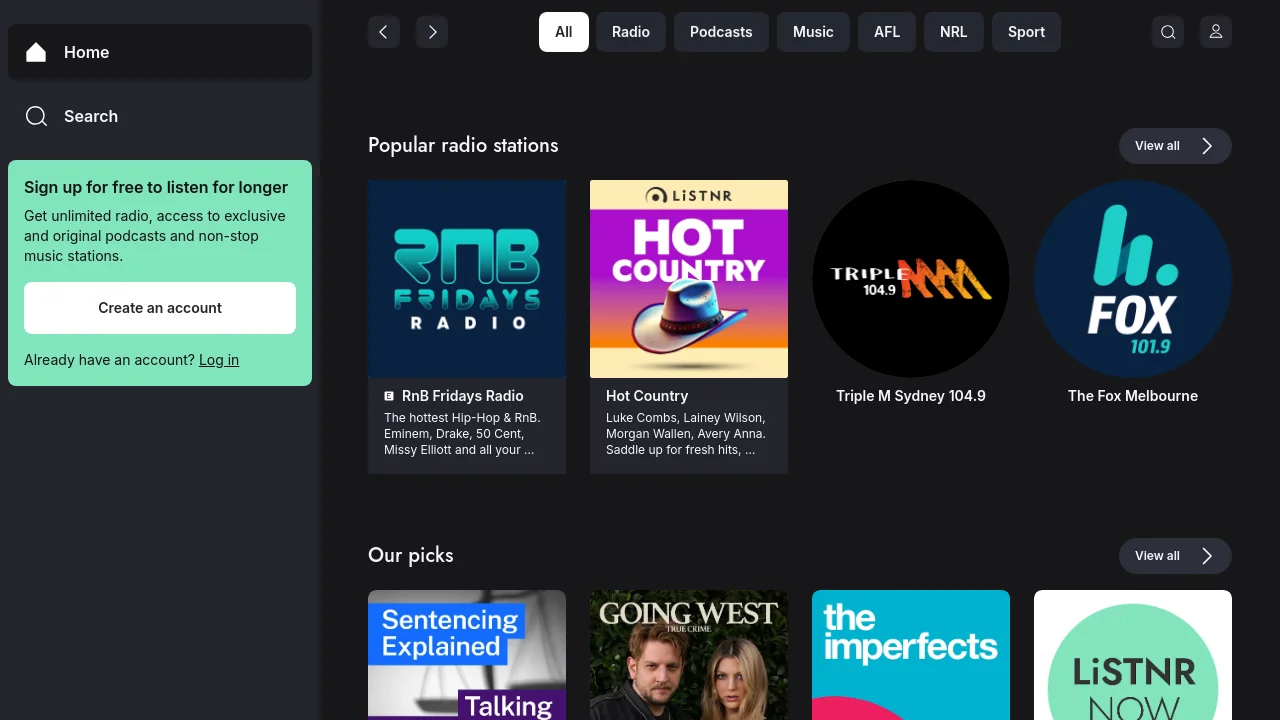
| Title: | LiSTNR - Web Player - Radio, Podcasts, Music, Sport |
| Description: | Discover LiSTNR, Australia’s leading audio destination offering radio, podcasts, music and live sport. Curated, personalised and free. |
| ip_address | 35.244.76.239 |
| country | AU  |
| network_name | Google LLC |
| asn | AS396982 |
80/tcp | http | nginx - |
443/tcp | https | nginx - |
| Software / Version | Category |
|---|---|
| core-js 2.5.7 | JavaScript libraries |
| Google Analytics | Analytics |
| GraphQL | Programming languages |
| GSAP | JavaScript frameworks |
| MySQL | Databases |
| Next.js 13.5.11 | JavaScript frameworks, Web frameworks, Web servers, Static site generator |
| Open Graph | Miscellaneous |
| PHP | Programming languages |
| React | JavaScript frameworks |
| Sentry | Issue trackers |
| styled-components 5.3.11 | JavaScript frameworks, Development |
| DoubleClick Floodlight | Advertising |
| PWA | Miscellaneous |
| Webpack | Miscellaneous |
| WordPress | CMS, Blogs |
| Airbridge 1.11.7 | Analytics |
| Apollo | JavaScript libraries |
| Contentful | CMS |
| Google Tag Manager | Tag managers |
| HSTS | Security |
| Salesforce Interaction Studio | Personalisation, Segmentation |
| TypeScript | Programming languages |
Web Application Vulnerabilities
Evidence
| CVE | CVSS | EPSS Score | EPSS Percentile | Summary |
|---|---|---|---|---|
| CVE-2025-67779 | 7.5 | 0.00378 | 0.59352 | It was found that the fix addressing CVE-2025-55184 in React Server Components was incomplete and does not prevent a denial of service attack in a specific case. React Server Components versions 19.0.2, 19.1.3 and 19.2.2 are affected, allowing unsafe deserialization of payloads from HTTP requests to Server Function endpoints. This can cause an infinite loop that hangs the server process and may prevent future HTTP requests from being served. |
| CVE-2025-55184 | 7.5 | 0.26234 | 0.96321 | A pre-authentication denial of service vulnerability exists in React Server Components versions 19.0.0, 19.0.1 19.1.0, 19.1.1, 19.1.2, 19.2.0 and 19.2.1, including the following packages: react-server-dom-parcel, react-server-dom-turbopack, and react-server-dom-webpack. The vulnerable code unsafely deserializes payloads from HTTP requests to Server Function endpoints, which can cause an infinite loop that hangs the server process and may prevent future HTTP requests from being served. |
| CVE-2024-51479 | 7.5 | 0.66731 | 0.98553 | Next.js is a React framework for building full-stack web applications. In affected versions if a Next.js application is performing authorization in middleware based on pathname, it was possible for this authorization to be bypassed for pages directly under the application's root directory. For example: * [Not affected] `https://example.com/` * [Affected] `https://example.com/foo` * [Not affected] `https://example.com/foo/bar`. This issue is patched in Next.js `14.2.15` and later. If your Next.js application is hosted on Vercel, this vulnerability has been automatically mitigated, regardless of Next.js version. There are no official workarounds for this vulnerability. |
| CVE-2024-34351 | 7.5 | 0.92751 | 0.99762 | Next.js is a React framework that can provide building blocks to create web applications. A Server-Side Request Forgery (SSRF) vulnerability was identified in Next.js Server Actions. If the `Host` header is modified, and the below conditions are also met, an attacker may be able to make requests that appear to be originating from the Next.js application server itself. The required conditions are 1) Next.js is running in a self-hosted manner; 2) the Next.js application makes use of Server Actions; and 3) the Server Action performs a redirect to a relative path which starts with a `/`. This vulnerability was fixed in Next.js `14.1.1`. |
| CVE-2026-27980 | 6.9 | 0.00022 | 0.06221 | Next.js is a React framework for building full-stack web applications. Starting in version 10.0.0 and prior to version 16.1.7, the default Next.js image optimization disk cache (`/_next/image`) did not have a configurable upper bound, allowing unbounded cache growth. An attacker could generate many unique image-optimization variants and exhaust disk space, causing denial of service. This is fixed in version 16.1.7 by adding an LRU-backed disk cache with `images.maximumDiskCacheSize`, including eviction of least-recently-used entries when the limit is exceeded. Setting `maximumDiskCacheSize: 0` disables disk caching. If upgrading is not immediately possible, periodically clean `.next/cache/images` and/or reduce variant cardinality (e.g., tighten values for `images.localPatterns`, `images.remotePatterns`, and `images.qualities`). |
Vulnerability description
Outdated or vulnerable software components include versions of server-side software that are no longer supported or have known, publicly disclosed vulnerabilities. Using outdated software significantly increases the attack surface of a system and may allow unauthorized access, data leaks, or service disruptions. Vulnerabilities in these components are often well-documented and actively exploited by attackers. Without security patches or vendor support, any weaknesses remain unmitigated, exposing the application to risks. In some cases, even after patching, the reported version may remain unchanged, requiring manual verification.
Risk description
The risk is that an attacker could search for an appropriate exploit (or create one himself) for any of these vulnerabilities and use it to attack the system. Since the vulnerabilities were discovered using only version-based testing, the risk level for this finding will not exceed 'high' severity. Critical risks will be assigned to vulnerabilities identified through accurate active testing methods.
Recommendation
In order to eliminate the risk of these vulnerabilities, we recommend you check the installed software version and upgrade to the latest version.
Classification
| CWE | CWE-1035 |
| OWASP Top 10 - 2017 | |
| OWASP Top 10 - 2021 |
Evidence
| Software / Version | Category |
|---|---|
| core-js 2.5.7 | JavaScript libraries |
| Google Analytics | Analytics |
| GraphQL | Programming languages |
| GSAP | JavaScript frameworks |
| MySQL | Databases |
| Next.js 13.5.11 | JavaScript frameworks, Web frameworks, Web servers, Static site generator |
| Open Graph | Miscellaneous |
| PHP | Programming languages |
| React | JavaScript frameworks |
| Sentry | Issue trackers |
| styled-components 5.3.11 | JavaScript frameworks, Development |
| DoubleClick Floodlight | Advertising |
| PWA | Miscellaneous |
| Webpack | Miscellaneous |
| WordPress | CMS, Blogs |
| Airbridge 1.11.7 | Analytics |
| Apollo | JavaScript libraries |
| Contentful | CMS |
| Google Tag Manager | Tag managers |
| HSTS | Security |
| Salesforce Interaction Studio | Personalisation, Segmentation |
| TypeScript | Programming languages |
Vulnerability description
We noticed that server software and technology details are exposed, potentially aiding attackers in tailoring specific exploits against identified systems and versions.
Risk description
The risk is that an attacker could use this information to mount specific attacks against the identified software type and version.
Recommendation
We recommend you to eliminate the information which permits the identification of software platform, technology, server and operating system: HTTP server headers, HTML meta information, etc.
Classification
| CWE | CWE-200 |
| OWASP Top 10 - 2017 | |
| OWASP Top 10 - 2021 |
Evidence
| URL | Evidence |
|---|---|
| https://bugfix-lf-1745-v2.replayer.listnr.dev.scadigital.com.au/ | Response does not include the HTTP Content-Security-Policy security header or meta tag |
Vulnerability description
We noticed that the target application lacks the Content-Security-Policy (CSP) header in its HTTP responses. The CSP header is a security measure that instructs web browsers to enforce specific security rules, effectively preventing the exploitation of Cross-Site Scripting (XSS) vulnerabilities.
Risk description
The risk is that if the target application is vulnerable to XSS, lack of this header makes it easily exploitable by attackers.
Recommendation
Configure the Content-Security-Header to be sent with each HTTP response in order to apply the specific policies needed by the application.
Classification
| CWE | CWE-1021 |
| OWASP Top 10 - 2017 | |
| OWASP Top 10 - 2021 |
Evidence
| URL | Evidence |
|---|---|
| https://bugfix-lf-1745-v2.replayer.listnr.dev.scadigital.com.au/ | Response headers do not include the Referrer-Policy HTTP security header as well as the |
Vulnerability description
We noticed that the target application's server responses lack the Referrer-Policy HTTP header, which controls how much referrer information the browser will send with each request originated from the current web application.
Risk description
The risk is that if a user visits a web page (e.g. "http://example.com/pricing/") and clicks on a link from that page going to e.g. "https://www.google.com", the browser will send to Google the full originating URL in the `Referer` header, assuming the Referrer-Policy header is not set. The originating URL could be considered sensitive information and it could be used for user tracking.
Recommendation
The Referrer-Policy header should be configured on the server side to avoid user tracking and inadvertent information leakage. The value `no-referrer` of this header instructs the browser to omit the Referer header entirely.
Classification
| CWE | CWE-693 |
| OWASP Top 10 - 2017 | |
| OWASP Top 10 - 2021 |
Evidence
| URL | Evidence |
|---|---|
| https://bugfix-lf-1745-v2.replayer.listnr.dev.scadigital.com.au/ | Response headers do not include the X-Content-Type-Options HTTP security header |
Vulnerability description
We noticed that the target application's server responses lack the X-Content-Type-Options header. This header is particularly important for preventing Internet Explorer from reinterpreting the content of a web page (MIME-sniffing) and thus overriding the value of the Content-Type header.
Risk description
The risk is that lack of this header could make possible attacks such as Cross-Site Scripting or phishing in Internet Explorer browsers.
Recommendation
We recommend setting the X-Content-Type-Options header such as `X-Content-Type-Options: nosniff`.
Classification
| CWE | CWE-693 |
| OWASP Top 10 - 2017 | |
| OWASP Top 10 - 2021 |
Vulnerability description
We found the robots.txt on the target server. This file instructs web crawlers what URLs and endpoints of the web application they can visit and crawl. Website administrators often misuse this file while attempting to hide some web pages from the users.
Risk description
There is no particular security risk in having a robots.txt file. However, it's important to note that adding endpoints in it should not be considered a security measure, as this file can be directly accessed and read by anyone.
Recommendation
We recommend you to manually review the entries from robots.txt and remove the ones which lead to sensitive locations in the website (ex. administration panels, configuration files, etc).
Evidence
Vulnerability description
We have noticed that the server is missing the security.txt file, which is considered a good practice for web security. It provides a standardized way for security researchers and the public to report security vulnerabilities or concerns by outlining the preferred method of contact and reporting procedures.
Risk description
There is no particular risk in not having a security.txt file for your server. However, this file is important because it offers a designated channel for reporting vulnerabilities and security issues.
Recommendation
We recommend you to implement the security.txt file according to the standard, in order to allow researchers or users report any security issues they find, improving the defensive mechanisms of your server.
Classification
| CWE | CWE-1188 |
| OWASP Top 10 - 2017 | |
| OWASP Top 10 - 2021 |
Evidence
| URL | Method | Parameters | Evidence |
|---|---|---|---|
| https://bugfix-lf-1745-v2.replayer.listnr.dev.scadigital.com.au/station/morning-yoga | GET | Headers: User-Agent=Mozilla/5.0 (Windows NT 10.0; Win64; x64) AppleWebKit/537.36 (KHTML, like Gecko) Chrome/108.0.0.0 Safari/537.36 | Email Address: info@dyfmpod.com hello@itsalotpodcast.com charlie@stihl.com.au |
Vulnerability description
We noticed that this web application exposes email addresses, which might be unintended. While not inherently a vulnerability, this information could be leveraged in social engineering or spam related activities.
Risk description
The risk is that exposed email addresses within the application could be accessed by unauthorized parties. This could lead to privacy violations, spam, phishing attacks, or other forms of misuse.
Recommendation
Compartmentalize the application to have 'safe' areas where trust boundaries can be unambiguously drawn. Do not allow email addresses to go outside of the trust boundary, and always be careful when interfacing with a compartment outside of the safe area.
Classification
| CWE | CWE-200 |
| OWASP Top 10 - 2017 | |
| OWASP Top 10 - 2021 |
Infrastructure Vulnerabilities
Evidence
| Software / Version | Category |
|---|---|
| Contentful | CMS |
| WordPress | CMS, Blogs |
| Next.js | JavaScript frameworks, Web frameworks, Web servers, Static site generator |
| MySQL | Databases |
| PHP | Programming languages |
| React | JavaScript frameworks |
| Salesforce Interaction Studio | Personalisation, Segmentation |
| Google Tag Manager | Tag managers |
| Google Analytics | Analytics |
| Airbridge | Analytics |
| DoubleClick Floodlight | Advertising |
| HSTS | Security |
| Webpack | Miscellaneous |
Vulnerability description
We noticed that server software and technology details are exposed, potentially aiding attackers in tailoring specific exploits against identified systems and versions.
Risk description
The risk is that an attacker could use this information to mount specific attacks against the identified software type and version.
Recommendation
We recommend you to eliminate the information which permits the identification of software platform, technology, server and operating system: HTTP server headers, HTML meta information, etc.
Evidence
| Operating System | Accuracy |
|---|---|
| Crestron XPanel control system | 90% |
Vulnerability description
OS Detection
Evidence
| Domain Queried | DNS Record Type | Description | Value |
|---|---|---|---|
| bugfix-lf-1745-v2.replayer.listnr.dev.scadigital.com.au | A | IPv4 address | 35.244.76.239 |
| bugfix-lf-1745-v2.replayer.listnr.dev.scadigital.com.au | TXT | Text record | "heritage=external-dns,external-dns/owner=external-dns-google.nonprod-good-dog.dev.scadigital.com.au,external-dns/resource=ingress/sca-listnr-replayer/listnr-replayer-dev-bugfix-lf-1745-v2-ingress-gcp" |
Risk description
An initial step for an attacker aiming to learn about an organization involves conducting searches on its domain names to uncover DNS records associated with the organization. This strategy aims to amass comprehensive insights into the target domain, enabling the attacker to outline the organization's external digital landscape. This gathered intelligence may subsequently serve as a foundation for launching attacks, including those based on social engineering techniques. DNS records pointing to services or servers that are no longer in use can provide an attacker with an easy entry point into the network.
Recommendation
We recommend reviewing all DNS records associated with the domain and identifying and removing unused or obsolete records.