Vulnerability Scan Result

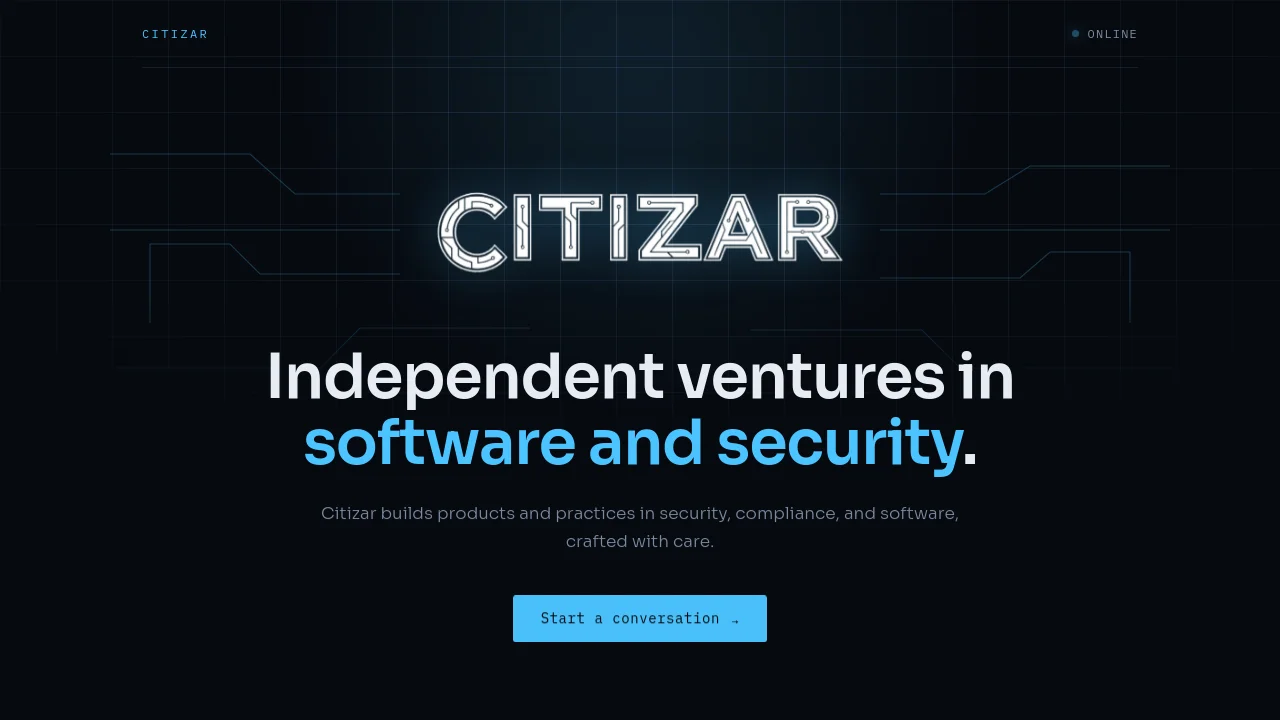
| Title: | Citizar · Independent ventures in software and security |
| Description: | Citizar builds products and practices in security, compliance, and software, each crafted with the same care. ISO 27001 and ABRO implementation, security leadership, and AI-accelerated delivery. |
| ip_address | 216.150.1.65 |
| country | US  |
| network_name | Amazon.com, Inc. |
| asn | AS16509 |
| ip_address | 216.150.16.65 |
| country | US |
| network_name | Amazon.com, Inc. |
| asn | AS16509 |
80/tcp | http | Vercel - |
443/tcp | https | Vercel - |
| Software / Version | Category |
|---|---|
| Next.js 16.2.9 | JavaScript frameworks, Web frameworks, Web servers, Static site generator |
| Next.js App Router | JavaScript frameworks, Web servers |
| Turbopack | Development |
| Open Graph | Miscellaneous |
| React | JavaScript frameworks |
| Vercel | PaaS |
| Webpack | Miscellaneous |
| Priority Hints | Performance |
| HSTS | Security |
Web Application Vulnerabilities
Evidence
| CVE | CVSS | EPSS Score | EPSS Percentile | Summary |
|---|---|---|---|---|
| CVE-2026-64649 | 8.3 | 0.00872 | 0.57369 | Next.js is a React framework for building full-stack web applications. In versions 14.1.1 through 15.5.20 and 16.0.0 through 16.2.10, when a Server Action forwards or redirects a request, an attacker can cause the server to send that outbound request to a malicious host (Server-Side Request Forgery). This requires the attacker's request to control Host-associated headers. In some configurations, it's also possible to obtain internal values that weaken middleware/proxy authorization. Applications that use Server Actions are affected when the incoming host header is not fixed to a trusted value. This typically occurs on custom servers, or on deployments not behind a proxy that pins the host. Managed hosting pins the host upstream and is not affected; next start and standalone output do the same from version 14.2 onward. This issue has been fixed in versions 15.5.21 and 16.2.11. |
| CVE-2026-64645 | 8.3 | 0.00837 | 0.56273 | Next.js is a React framework for building full-stack web applications. In versions 12.0.0 through 15.5.20 and 16.0.0 through 16.2.10, a rewrites() or redirects() rule that builds its external destination hostname from request-controlled input can be pointed at an arbitrary hostname, regardless of the rule's hostname suffix. For a rewrite, Next.js proxies the request to that arbitrary host and serves the response from the application's origin, leading to Server-Side Request forgery. A redirects() rule configured this way is vulnerable to an Open Redirect. This issue has been fixed in versions 15.5.21 and 16.2.11. |
| CVE-2026-64642 | 8.3 | 0.01164 | 0.65901 | Next.js is a React framework for building full-stack web applications. In versions 16.0.0 through 16.2.10, crafted requests targeting Next.js applications using App Router built with Turbopack and a single entry in config.i18n.locales can bypass middleware/proxy based authentication. This issue has been fixed in version 16.2.11. |
| CVE-2026-64641 | 8.2 | 0.01375 | 0.70844 | Next.js is a React framework for building full-stack web applications. In versions 13.0.0 through 15.5.20 and 16.0.0 through 16.2.10, crafted requests targeting Next.js applications using App Router with at least one Server Action can lead to excessive CPU usage blocking processing of further requests in the same process. This issue has been fixed in versions 15.5.21 and 16.2.11. |
| CVE-2026-64647 | 6.3 | 0.00351 | 0.28848 | Next.js is a React framework for building full-stack web applications. In versions 12.0.0 through 15.5.20 and 16.0.0 through 16.2.10, a server-side fetch with a request body may return a cached response body from a different request to the same URL but different body. Confidential data in the POST's response body would then leak to unauthorized requests. Though the request itself will not be deduped. This is only an issue when receiving request bodies with a content type charset other than UTF-8. For example, the UTF-16 byte sequences for 삃삃 and 섄섄 in the request body would share the same cache. This issue has been fixed in versions 15.5.21 and 16.2.11. |
Vulnerability description
Outdated or vulnerable software components include versions of server-side software that are no longer supported or have known, publicly disclosed vulnerabilities. Using outdated software significantly increases the attack surface of a system and may allow unauthorized access, data leaks, or service disruptions. Vulnerabilities in these components are often well-documented and actively exploited by attackers. Without security patches or vendor support, any weaknesses remain unmitigated, exposing the application to risks. In some cases, even after patching, the reported version may remain unchanged, requiring manual verification.
Risk description
The risk is that an attacker could search for an appropriate exploit (or create one himself) for any of these vulnerabilities and use it to attack the system. Since the vulnerabilities were discovered using only version-based testing, the risk level for this finding will not exceed 'high' severity. Critical risks will be assigned to vulnerabilities identified through accurate active testing methods.
Recommendation
In order to eliminate the risk of these vulnerabilities, we recommend you check the installed software version and upgrade to the latest version.
Classification
| CWE | CWE-1035 |
| OWASP Top 10 - 2017 | |
| OWASP Top 10 - 2021 |
Evidence
| URL | Evidence |
|---|---|
| https://www.citizar.nl/ | Response headers include the HTTP Content-Security-Policy security header with the following security issues: |
Vulnerability description
We noticed that the Content-Security-Policy (CSP) header configured for the web application includes unsafe directives. The CSP header activates a protection mechanism implemented in web browsers which prevents exploitation of Cross-Site Scripting vulnerabilities (XSS) by restricting the sources from which content can be loaded or executed.
Risk description
For example, if the unsafe-inline directive is present in the CSP header, the execution of inline scripts and event handlers is allowed. This can be exploited by an attacker to execute arbitrary JavaScript code in the context of the vulnerable application.
Recommendation
Remove the unsafe values from the directives, adopt nonces or hashes for safer inclusion of inline scripts if they are needed, and explicitly define the sources from which scripts, styles, images or other resources can be loaded.
Classification
| CWE | CWE-1021 |
| OWASP Top 10 - 2017 | |
| OWASP Top 10 - 2021 |
Evidence
| Software / Version | Category |
|---|---|
| Next.js 16.2.9 | JavaScript frameworks, Web frameworks, Web servers, Static site generator |
| Next.js App Router | JavaScript frameworks, Web servers |
| Turbopack | Development |
| Open Graph | Miscellaneous |
| React | JavaScript frameworks |
| Vercel | PaaS |
| Webpack | Miscellaneous |
| Priority Hints | Performance |
| HSTS | Security |
Vulnerability description
We noticed that server software and technology details are exposed, potentially aiding attackers in tailoring specific exploits against identified systems and versions.
Risk description
The risk is that an attacker could use this information to mount specific attacks against the identified software type and version.
Recommendation
We recommend you to eliminate the information which permits the identification of software platform, technology, server and operating system: HTTP server headers, HTML meta information, etc.
Classification
| CWE | CWE-200 |
| OWASP Top 10 - 2017 | |
| OWASP Top 10 - 2021 |
Evidence
| URL | Method | Parameters | Evidence |
|---|---|---|---|
| https://www.citizar.nl/privacyverklaring | GET | Headers: User-Agent=Mozilla/5.0 (X11; Linux x86_64) AppleWebKit/537.36 (KHTML, like Gecko) Chrome/108.0.0.0 Safari/537.36 |
Vulnerability description
We noticed that this web application exposes email addresses, which might be unintended. While not inherently a vulnerability, this information could be leveraged in social engineering or spam related activities.
Risk description
The risk is that exposed email addresses within the application could be accessed by unauthorized parties. This could lead to privacy violations, spam, phishing attacks, or other forms of misuse.
Recommendation
Compartmentalize the application to have 'safe' areas where trust boundaries can be unambiguously drawn. Do not allow email addresses to go outside of the trust boundary, and always be careful when interfacing with a compartment outside of the safe area.
Classification
| CWE | CWE-200 |
| OWASP Top 10 - 2017 | |
| OWASP Top 10 - 2021 |
Vulnerability description
We have noticed that the server is missing the security.txt file, which is considered a good practice for web security. It provides a standardized way for security researchers and the public to report security vulnerabilities or concerns by outlining the preferred method of contact and reporting procedures.
Risk description
There is no particular risk in not having a security.txt file for your server. However, this file is important because it offers a designated channel for reporting vulnerabilities and security issues.
Recommendation
We recommend you to implement the security.txt file according to the standard, in order to allow researchers or users report any security issues they find, improving the defensive mechanisms of your server.
Classification
| CWE | CWE-1188 |
| OWASP Top 10 - 2017 | |
| OWASP Top 10 - 2021 |
Infrastructure Vulnerabilities
Evidence
| CVE | CVSS | EPSS Score | EPSS Percentile | CISA KEV | Summary |
|---|---|---|---|---|---|
| CVE-2026-64649 | 8.3 | 0.00872 | 0.57369 | No | Next.js is a React framework for building full-stack web applications. In versions 14.1.1 through 15.5.20 and 16.0.0 through 16.2.10, when a Server Action forwards or redirects a request, an attacker can cause the server to send that outbound request to a malicious host (Server-Side Request Forgery). This requires the attacker's request to control Host-associated headers. In some configurations, it's also possible to obtain internal values that weaken middleware/proxy authorization. Applications that use Server Actions are affected when the incoming host header is not fixed to a trusted value. This typically occurs on custom servers, or on deployments not behind a proxy that pins the host. Managed hosting pins the host upstream and is not affected; next start and standalone output do the same from version 14.2 onward. This issue has been fixed in versions 15.5.21 and 16.2.11. |
| CVE-2026-64645 | 8.3 | 0.00837 | 0.56273 | No | Next.js is a React framework for building full-stack web applications. In versions 12.0.0 through 15.5.20 and 16.0.0 through 16.2.10, a rewrites() or redirects() rule that builds its external destination hostname from request-controlled input can be pointed at an arbitrary hostname, regardless of the rule's hostname suffix. For a rewrite, Next.js proxies the request to that arbitrary host and serves the response from the application's origin, leading to Server-Side Request forgery. A redirects() rule configured this way is vulnerable to an Open Redirect. This issue has been fixed in versions 15.5.21 and 16.2.11. |
| CVE-2026-64642 | 8.3 | 0.01164 | 0.65901 | No | Next.js is a React framework for building full-stack web applications. In versions 16.0.0 through 16.2.10, crafted requests targeting Next.js applications using App Router built with Turbopack and a single entry in config.i18n.locales can bypass middleware/proxy based authentication. This issue has been fixed in version 16.2.11. |
| CVE-2026-64641 | 8.2 | 0.01375 | 0.70844 | No | Next.js is a React framework for building full-stack web applications. In versions 13.0.0 through 15.5.20 and 16.0.0 through 16.2.10, crafted requests targeting Next.js applications using App Router with at least one Server Action can lead to excessive CPU usage blocking processing of further requests in the same process. This issue has been fixed in versions 15.5.21 and 16.2.11. |
| CVE-2026-64647 | 6.3 | 0.00351 | 0.28848 | No | Next.js is a React framework for building full-stack web applications. In versions 12.0.0 through 15.5.20 and 16.0.0 through 16.2.10, a server-side fetch with a request body may return a cached response body from a different request to the same URL but different body. Confidential data in the POST's response body would then leak to unauthorized requests. Though the request itself will not be deduped. This is only an issue when receiving request bodies with a content type charset other than UTF-8. For example, the UTF-16 byte sequences for 삃삃 and 섄섄 in the request body would share the same cache. This issue has been fixed in versions 15.5.21 and 16.2.11. |
Vulnerability description
Vulnerabilities found for Next.js 16.2.9
Risk description
These vulnerabilities expose the affected applications to the risk of unauthorized access to confidential data and possibly to denial of service attacks. An attacker could search for an appropriate exploit (or create one) for any of these vulnerabilities and use it to attack the system. Notes: - The vulnerabilities are identified based on the server's version.; - Only the first 5 vulnerabilities with the highest risk are shown for each port.; Since the vulnerabilities were discovered using only version-based testing, the risk level for this finding will not exceed "high" severity. Critical risks will be assigned to vulnerabilities identified through accurate active testing methods.
Recommendation
We recommend you to upgrade the affected software to the latest version in order to eliminate the risks imposed by these vulnerabilities.
Evidence
| Domain Queried | DNS Record Type | Description | Value |
|---|---|---|---|
| www.citizar.nl | A | IPv4 address | 216.150.1.1 |
| www.citizar.nl | A | IPv4 address | 216.150.16.1 |
| www.citizar.nl | CAA | Certificate Authority Authorization | 0 issue "globalsign.com" |
| www.citizar.nl | CAA | Certificate Authority Authorization | 0 issue "letsencrypt.org" |
| www.citizar.nl | CAA | Certificate Authority Authorization | 0 issue "pki.goog" |
| www.citizar.nl | CAA | Certificate Authority Authorization | 0 issue "sectigo.com" |
| www.citizar.nl | CNAME | Canonical name | 79ef0f6d6a4e1eee.vercel-dns-016.com |
Risk description
An initial step for an attacker aiming to learn about an organization involves conducting searches on its domain names to uncover DNS records associated with the organization. This strategy aims to amass comprehensive insights into the target domain, enabling the attacker to outline the organization's external digital landscape. This gathered intelligence may subsequently serve as a foundation for launching attacks, including those based on social engineering techniques. DNS records pointing to services or servers that are no longer in use can provide an attacker with an easy entry point into the network.
Recommendation
We recommend reviewing all DNS records associated with the domain and identifying and removing unused or obsolete records.
Evidence
| Software / Version | Category |
|---|---|
| Next.js 16.2.9 | JavaScript frameworks, Web frameworks, Web servers, Static site generator |
| Turbopack | Development |
| React | JavaScript frameworks |
| Next.js App Router | JavaScript frameworks, Web servers |
| Vercel | PaaS |
| Priority Hints | Performance |
| HSTS | Security |
| Webpack | Miscellaneous |
| Open Graph | Miscellaneous |
Vulnerability description
We noticed that server software and technology details are exposed, potentially aiding attackers in tailoring specific exploits against identified systems and versions.
Risk description
The risk is that an attacker could use this information to mount specific attacks against the identified software type and version.
Recommendation
We recommend you to eliminate the information which permits the identification of software platform, technology, server and operating system: HTTP server headers, HTML meta information, etc.