Vulnerability Scan Result

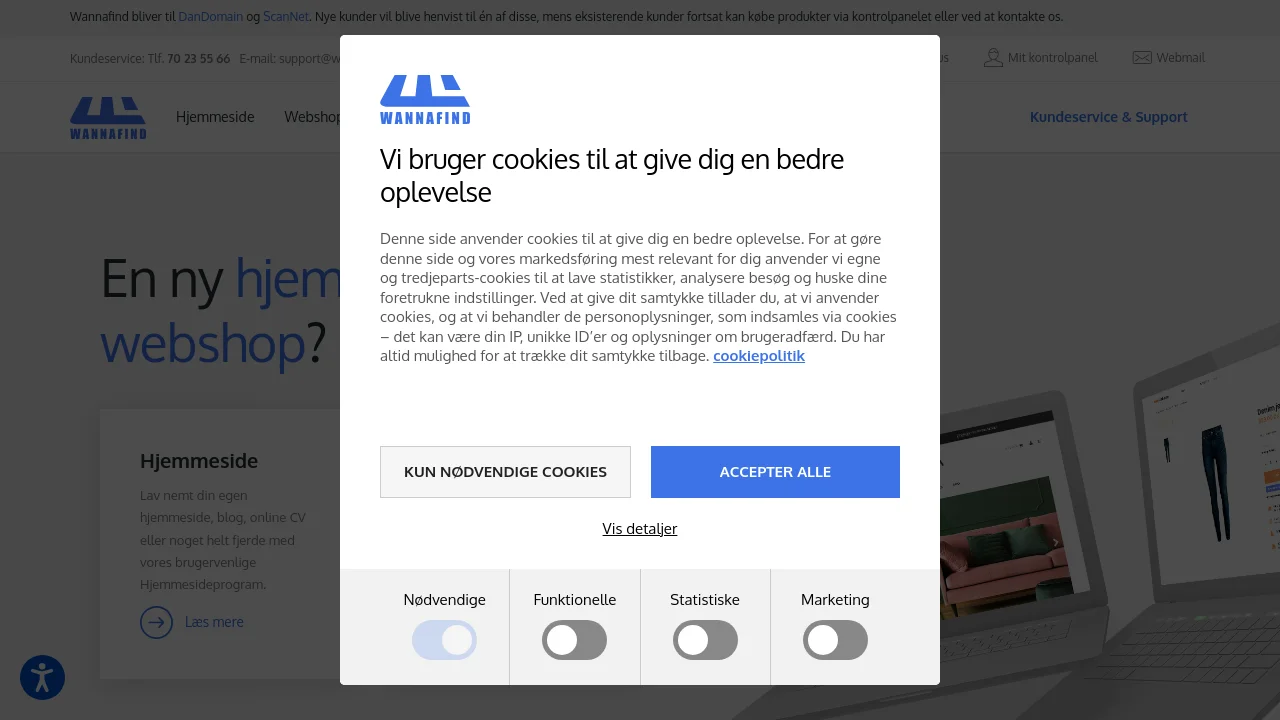
| Title: | Wannafind - Danmarks bedste udvalg af hostingløsninger |
| Description: | Hosting af alt fra webshops, webhoteller og servere til hostede Microsoft-produkter som Exchange og C5. Høj kvalitet og markedets bedste kundeservice. |
| ip_address | 46.36.209.6 |
| country | DK  |
| network_name | team.blue Denmark A/S |
| asn | AS48854 |
80/tcp | http | - - |
443/tcp | https | - - |
| Software / Version | Category |
|---|---|
| AccessiBe | Accessibility |
| AngularJS 1.8.2 | JavaScript frameworks |
| Trustpilot | Reviews |
| Cookie Information | Cookie compliance |
| Facebook Pixel 2.9.300 | Analytics |
| Bootstrap 3.3.7 | UI frameworks |
| toastr 2.1.0 | JavaScript frameworks |
| jQuery Migrate 3.3.0 | JavaScript libraries |
| core-js 3.32.2 | JavaScript libraries |
| Google Analytics | Analytics |
| jQuery 3.5.1 | JavaScript libraries |
| Modernizr 2.6.2 | JavaScript libraries |
| MySQL | Databases |
| PHP | Programming languages |
| Sectigo | SSL/TLS certificate authorities |
| DoubleClick Floodlight | Advertising |
| VWO | Analytics, A/B Testing |
| WordPress | CMS, Blogs |
| Microsoft ASP.NET | Web frameworks |
| Freshworks CRM | CRM, Marketing automation, A/B Testing |
| Google Tag Manager | Tag managers |
| Hotjar | Analytics |
| HSTS | Security |
| Varnish | Caching |
Web Application Vulnerabilities
Evidence
| CVE | CVSS | EPSS Score | EPSS Percentile | Summary |
|---|---|---|---|---|
| CVE-2023-26118 | 5.3 | 0.00526 | 0.67033 | Versions of the package angular from 1.4.9 are vulnerable to Regular Expression Denial of Service (ReDoS) via the <input type="url"> element due to the usage of an insecure regular expression in the input[url] functionality. Exploiting this vulnerability is possible by a large carefully-crafted input, which can result in catastrophic backtracking. |
| CVE-2023-26117 | 5.3 | 0.00274 | 0.50878 | Versions of the package angular from 1.0.0 are vulnerable to Regular Expression Denial of Service (ReDoS) via the $resource service due to the usage of an insecure regular expression. Exploiting this vulnerability is possible by a large carefully-crafted input, which can result in catastrophic backtracking. |
| CVE-2023-26116 | 5.3 | 0.00274 | 0.50878 | Versions of the package angular from 1.2.21 are vulnerable to Regular Expression Denial of Service (ReDoS) via the angular.copy() utility function due to the usage of an insecure regular expression. Exploiting this vulnerability is possible by a large carefully-crafted input, which can result in catastrophic backtracking. |
| CVE-2022-25844 | 5.3 | 0.01924 | 0.83401 | The package angular after 1.7.0 are vulnerable to Regular Expression Denial of Service (ReDoS) by providing a custom locale rule that makes it possible to assign the parameter in posPre: ' '.repeat() of NUMBER_FORMATS.PATTERNS[1].posPre with a very high value. **Note:** 1) This package has been deprecated and is no longer maintained. 2) The vulnerable versions are 1.7.0 and higher. |
| CVE-2024-8373 | 4.8 | 0.00013 | 0.02227 | Improper sanitization of the value of the [srcset] attribute in <source> HTML elements in AngularJS allows attackers to bypass common image source restrictions, which can also lead to a form of Content Spoofing https://owasp.org/www-community/attacks/Content_Spoofing . This issue affects all versions of AngularJS. Note: The AngularJS project is End-of-Life and will not receive any updates to address this issue. For more information see here https://docs.angularjs.org/misc/version-support-status . |
Vulnerability description
Outdated or vulnerable software components include versions of server-side software that are no longer supported or have known, publicly disclosed vulnerabilities. Using outdated software significantly increases the attack surface of a system and may allow unauthorized access, data leaks, or service disruptions. Vulnerabilities in these components are often well-documented and actively exploited by attackers. Without security patches or vendor support, any weaknesses remain unmitigated, exposing the application to risks. In some cases, even after patching, the reported version may remain unchanged, requiring manual verification.
Risk description
The risk is that an attacker could search for an appropriate exploit (or create one himself) for any of these vulnerabilities and use it to attack the system. Since the vulnerabilities were discovered using only version-based testing, the risk level for this finding will not exceed 'high' severity. Critical risks will be assigned to vulnerabilities identified through accurate active testing methods.
Recommendation
In order to eliminate the risk of these vulnerabilities, we recommend you check the installed software version and upgrade to the latest version.
Classification
| CWE | CWE-1035 |
| OWASP Top 10 - 2017 | |
| OWASP Top 10 - 2021 |
Evidence
| CVE | CVSS | EPSS Score | EPSS Percentile | Summary |
|---|---|---|---|---|
| CVE-2024-6484 | 6.4 | 0.00049 | 0.15167 | A vulnerability has been identified in Bootstrap that exposes users to Cross-Site Scripting (XSS) attacks. The issue is present in the carousel component, where the data-slide and data-slide-to attributes can be exploited through the href attribute of an <a> tag due to inadequate sanitization. This vulnerability could potentially enable attackers to execute arbitrary JavaScript within the victim's browser. |
| CVE-2019-8331 | 6.1 | 0.01668 | 0.82139 | In Bootstrap before 3.4.1 and 4.3.x before 4.3.1, XSS is possible in the tooltip or popover data-template attribute. |
| CVE-2018-20677 | 6.1 | 0.1017 | 0.93129 | In Bootstrap before 3.4.0, XSS is possible in the affix configuration target property. |
| CVE-2018-20676 | 6.1 | 0.05658 | 0.90386 | In Bootstrap before 3.4.0, XSS is possible in the tooltip data-viewport attribute. |
| CVE-2018-14042 | 6.1 | 0.02343 | 0.84897 | In Bootstrap before 4.1.2, XSS is possible in the data-container property of tooltip. |
Vulnerability description
Outdated or vulnerable software components include versions of server-side software that are no longer supported or have known, publicly disclosed vulnerabilities. Using outdated software significantly increases the attack surface of a system and may allow unauthorized access, data leaks, or service disruptions. Vulnerabilities in these components are often well-documented and actively exploited by attackers. Without security patches or vendor support, any weaknesses remain unmitigated, exposing the application to risks. In some cases, even after patching, the reported version may remain unchanged, requiring manual verification.
Risk description
The risk is that an attacker could search for an appropriate exploit (or create one himself) for any of these vulnerabilities and use it to attack the system. Since the vulnerabilities were discovered using only version-based testing, the risk level for this finding will not exceed 'high' severity. Critical risks will be assigned to vulnerabilities identified through accurate active testing methods.
Recommendation
In order to eliminate the risk of these vulnerabilities, we recommend you check the installed software version and upgrade to the latest version.
Classification
| CWE | CWE-1035 |
| OWASP Top 10 - 2017 | |
| OWASP Top 10 - 2021 |
Evidence
| URL | Evidence |
|---|---|
| https://www.wannafind.dk/ | Response does not include the HTTP Content-Security-Policy security header or meta tag |
Vulnerability description
We noticed that the target application lacks the Content-Security-Policy (CSP) header in its HTTP responses. The CSP header is a security measure that instructs web browsers to enforce specific security rules, effectively preventing the exploitation of Cross-Site Scripting (XSS) vulnerabilities.
Risk description
The risk is that if the target application is vulnerable to XSS, lack of this header makes it easily exploitable by attackers.
Recommendation
Configure the Content-Security-Header to be sent with each HTTP response in order to apply the specific policies needed by the application.
Classification
| CWE | CWE-1021 |
| OWASP Top 10 - 2017 | |
| OWASP Top 10 - 2021 |
Evidence
| Software / Version | Category |
|---|---|
| AccessiBe | Accessibility |
| AngularJS 1.8.2 | JavaScript frameworks |
| Trustpilot | Reviews |
| Cookie Information | Cookie compliance |
| Facebook Pixel 2.9.300 | Analytics |
| Bootstrap 3.3.7 | UI frameworks |
| toastr 2.1.0 | JavaScript frameworks |
| jQuery Migrate 3.3.0 | JavaScript libraries |
| core-js 3.32.2 | JavaScript libraries |
| Google Analytics | Analytics |
| jQuery 3.5.1 | JavaScript libraries |
| Modernizr 2.6.2 | JavaScript libraries |
| MySQL | Databases |
| PHP | Programming languages |
| Sectigo | SSL/TLS certificate authorities |
| DoubleClick Floodlight | Advertising |
| VWO | Analytics, A/B Testing |
| WordPress | CMS, Blogs |
| Microsoft ASP.NET | Web frameworks |
| Freshworks CRM | CRM, Marketing automation, A/B Testing |
| Google Tag Manager | Tag managers |
| Hotjar | Analytics |
| HSTS | Security |
| Varnish | Caching |
Vulnerability description
We noticed that server software and technology details are exposed, potentially aiding attackers in tailoring specific exploits against identified systems and versions.
Risk description
The risk is that an attacker could use this information to mount specific attacks against the identified software type and version.
Recommendation
We recommend you to eliminate the information which permits the identification of software platform, technology, server and operating system: HTTP server headers, HTML meta information, etc.
Classification
| CWE | CWE-200 |
| OWASP Top 10 - 2017 | |
| OWASP Top 10 - 2021 |
Evidence
| URL | Method | Parameters | Evidence |
|---|---|---|---|
| https://www.wannafind.dk/ | GET | Headers: User-Agent=Mozilla/5.0 (Windows NT 10.0; Win64; x64) AppleWebKit/537.36 (KHTML, like Gecko) Chrome/108.0.0.0 Safari/537.36 | Email Address: support@wannafind.dk |
Vulnerability description
We noticed that this web application exposes email addresses, which might be unintended. While not inherently a vulnerability, this information could be leveraged in social engineering or spam related activities.
Risk description
The risk is that exposed email addresses within the application could be accessed by unauthorized parties. This could lead to privacy violations, spam, phishing attacks, or other forms of misuse.
Recommendation
Compartmentalize the application to have 'safe' areas where trust boundaries can be unambiguously drawn. Do not allow email addresses to go outside of the trust boundary, and always be careful when interfacing with a compartment outside of the safe area.
Classification
| CWE | CWE-200 |
| OWASP Top 10 - 2017 | |
| OWASP Top 10 - 2021 |
Evidence
| URL | Method | Summary |
|---|---|---|
| https://www.wannafind.dk/ | OPTIONS | We did a HTTP OPTIONS request. The server responded with a 200 status code and the header: `Allow: OPTIONS, TRACE, GET, HEAD, POST` Request / Response |
Vulnerability description
We have noticed that the webserver responded with an Allow HTTP header when an OPTIONS HTTP request was sent. This method responds to requests by providing information about the methods available for the target resource.
Risk description
The only risk this might present nowadays is revealing debug HTTP methods that can be used on the server. This can present a danger if any of those methods can lead to sensitive information, like authentication information, secret keys.
Recommendation
We recommend that you check for unused HTTP methods or even better, disable the OPTIONS method. This can be done using your webserver configuration.
Classification
| CWE | CWE-16 |
| OWASP Top 10 - 2017 | |
| OWASP Top 10 - 2021 |
Infrastructure Vulnerabilities
Evidence
| Operating System | Accuracy |
|---|---|
| Linux 4.0 | 94% |
Vulnerability description
OS Detection
Evidence
| Software / Version | Category |
|---|---|
| WordPress | CMS, Blogs |
| MySQL | Databases |
| PHP | Programming languages |
| Microsoft ASP.NET | Web frameworks |
| Bootstrap 5 | UI frameworks |
| Varnish | Caching |
| VWO | Analytics, A/B Testing |
| Trustpilot | Reviews |
| Hotjar | Analytics |
| Google Tag Manager | Tag managers |
| Google Analytics | Analytics |
| Facebook Pixel 2.9.300 | Analytics |
| DoubleClick Floodlight | Advertising |
| Sectigo | SSL/TLS certificate authorities |
| HSTS | Security |
Vulnerability description
We noticed that server software and technology details are exposed, potentially aiding attackers in tailoring specific exploits against identified systems and versions.
Risk description
The risk is that an attacker could use this information to mount specific attacks against the identified software type and version.
Recommendation
We recommend you to eliminate the information which permits the identification of software platform, technology, server and operating system: HTTP server headers, HTML meta information, etc.
Evidence
| Domain Queried | DNS Record Type | Description | Value |
|---|---|---|---|
| www.wannafind.dk | A | IPv4 address | 46.36.209.6 |
Risk description
An initial step for an attacker aiming to learn about an organization involves conducting searches on its domain names to uncover DNS records associated with the organization. This strategy aims to amass comprehensive insights into the target domain, enabling the attacker to outline the organization's external digital landscape. This gathered intelligence may subsequently serve as a foundation for launching attacks, including those based on social engineering techniques. DNS records pointing to services or servers that are no longer in use can provide an attacker with an easy entry point into the network.
Recommendation
We recommend reviewing all DNS records associated with the domain and identifying and removing unused or obsolete records.