Vulnerability Scan Result

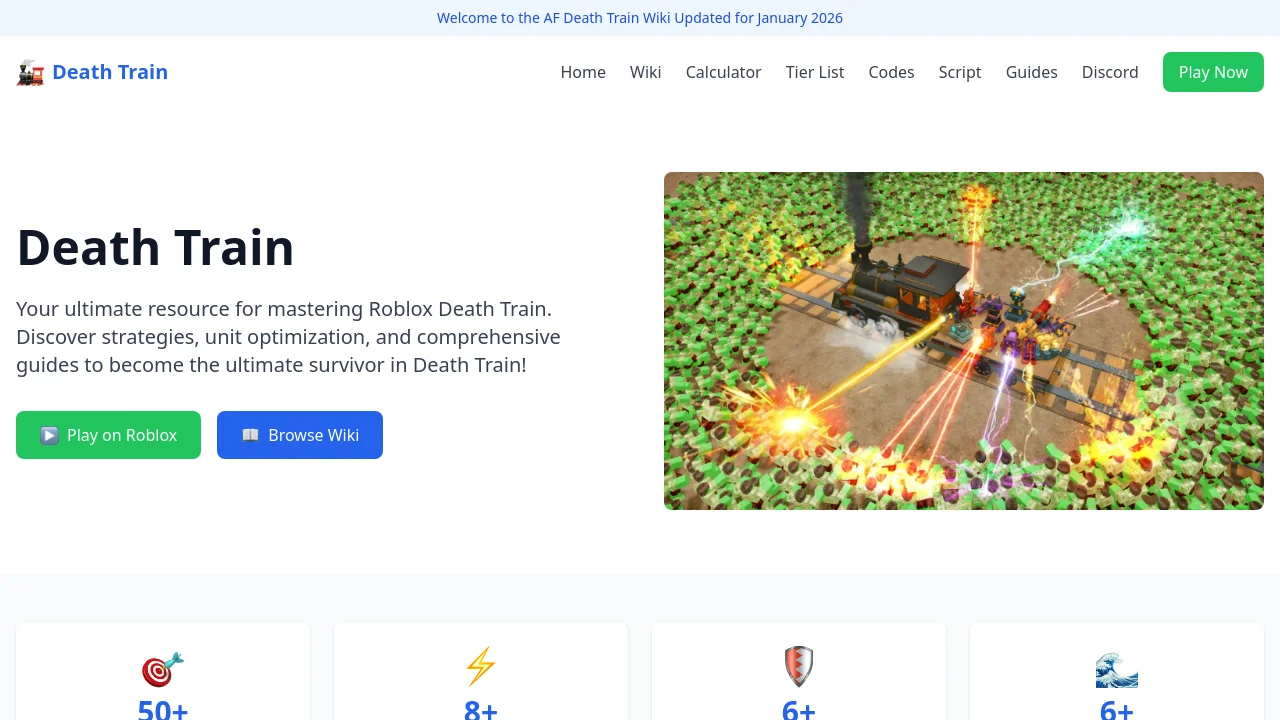
| Title: | Death Train - Ultimate Roblox Game Resource |
| Description: | Comprehensive guides, calculators, and resources for mastering Death Train on Roblox. Discover strategies, unit optimization, and comprehensive guides to become the ultimate survivor in Death Train! |
| ip_address | 172.66.44.203 |
| country | - |
| network_name | Cloudflare, Inc. |
| asn | AS13335 |
| ip_address | 172.66.47.53 |
| country | - |
| network_name | Cloudflare, Inc. |
| asn | AS13335 |
80/tcp | http | Cloudflare http proxy - |
443/tcp | https | cloudflare - |
2082/tcp | http | Cloudflare http proxy - |
2083/tcp | https | nginx - |
2086/tcp | http | Cloudflare http proxy - |
2087/tcp | https | nginx - |
8080/tcp | http | Cloudflare http proxy - |
8443/tcp | https-alt | cloudflare - |
| Software / Version | Category |
|---|---|
| HTTP/3 | Miscellaneous |
| Next.js 14.2.35 | JavaScript frameworks, Web frameworks, Web servers, Static site generator |
| Next.js App Router | JavaScript frameworks, Web servers |
| React | JavaScript frameworks |
| Webpack | Miscellaneous |
| Priority Hints | Performance |
| Cloudflare | CDN |
| HSTS | Security |
Web Application Vulnerabilities
Evidence
| CVE | CVSS | EPSS Score | EPSS Percentile | Summary |
|---|---|---|---|---|
| CVE-2026-27980 | 6.9 | 0.00022 | 0.06231 | Next.js is a React framework for building full-stack web applications. Starting in version 10.0.0 and prior to version 16.1.7, the default Next.js image optimization disk cache (`/_next/image`) did not have a configurable upper bound, allowing unbounded cache growth. An attacker could generate many unique image-optimization variants and exhaust disk space, causing denial of service. This is fixed in version 16.1.7 by adding an LRU-backed disk cache with `images.maximumDiskCacheSize`, including eviction of least-recently-used entries when the limit is exceeded. Setting `maximumDiskCacheSize: 0` disables disk caching. If upgrading is not immediately possible, periodically clean `.next/cache/images` and/or reduce variant cardinality (e.g., tighten values for `images.localPatterns`, `images.remotePatterns`, and `images.qualities`). |
| CVE-2026-29057 | 6.3 | 0.00031 | 0.08921 | Next.js is a React framework for building full-stack web applications. Starting in version 9.5.0 and prior to versions 15.5.13 and 16.1.7, when Next.js rewrites proxy traffic to an external backend, a crafted `DELETE`/`OPTIONS` request using `Transfer-Encoding: chunked` could trigger request boundary disagreement between the proxy and backend. This could allow request smuggling through rewritten routes. An attacker could smuggle a second request to unintended backend routes (for example, internal/admin endpoints), bypassing assumptions that only the configured rewrite destination/path is reachable. This does not impact applications hosted on providers that handle rewrites at the CDN level, such as Vercel. The vulnerability originated in an upstream library vendored by Next.js. It is fixed in Next.js 15.5.13 and 16.1.7 by updating that dependency’s behavior so `content-length: 0` is added only when both `content-length` and `transfer-encoding` are absent, and `transfer-encoding` is no longer removed in that code path. If upgrading is not immediately possible, block chunked `DELETE`/`OPTIONS` requests on rewritten routes at the edge/proxy, and/or enforce authentication/authorization on backend routes. |
| CVE-2025-59471 | 5.9 | 0.00027 | 0.07661 | A denial of service vulnerability exists in self-hosted Next.js applications that have `remotePatterns` configured for the Image Optimizer. The image optimization endpoint (`/_next/image`) loads external images entirely into memory without enforcing a maximum size limit, allowing an attacker to cause out-of-memory conditions by requesting optimization of arbitrarily large images. This vulnerability requires that `remotePatterns` is configured to allow image optimization from external domains and that the attacker can serve or control a large image on an allowed domain. Strongly consider upgrading to 15.5.10 or 16.1.5 to reduce risk and prevent availability issues in Next applications. |
Vulnerability description
Outdated or vulnerable software components include versions of server-side software that are no longer supported or have known, publicly disclosed vulnerabilities. Using outdated software significantly increases the attack surface of a system and may allow unauthorized access, data leaks, or service disruptions. Vulnerabilities in these components are often well-documented and actively exploited by attackers. Without security patches or vendor support, any weaknesses remain unmitigated, exposing the application to risks. In some cases, even after patching, the reported version may remain unchanged, requiring manual verification.
Risk description
The risk is that an attacker could search for an appropriate exploit (or create one himself) for any of these vulnerabilities and use it to attack the system. Since the vulnerabilities were discovered using only version-based testing, the risk level for this finding will not exceed 'high' severity. Critical risks will be assigned to vulnerabilities identified through accurate active testing methods.
Recommendation
In order to eliminate the risk of these vulnerabilities, we recommend you check the installed software version and upgrade to the latest version.
Classification
| CWE | CWE-1035 |
| OWASP Top 10 - 2017 | |
| OWASP Top 10 - 2021 |
Evidence
| URL | Evidence |
|---|---|
| https://deathtraingame-com.pages.dev/ | Response does not include the HTTP Content-Security-Policy security header or meta tag |
Vulnerability description
We noticed that the target application lacks the Content-Security-Policy (CSP) header in its HTTP responses. The CSP header is a security measure that instructs web browsers to enforce specific security rules, effectively preventing the exploitation of Cross-Site Scripting (XSS) vulnerabilities.
Risk description
The risk is that if the target application is vulnerable to XSS, lack of this header makes it easily exploitable by attackers.
Recommendation
Configure the Content-Security-Header to be sent with each HTTP response in order to apply the specific policies needed by the application.
Classification
| CWE | CWE-1021 |
| OWASP Top 10 - 2017 | |
| OWASP Top 10 - 2021 |
Evidence
Vulnerability description
We found the robots.txt on the target server. This file instructs web crawlers what URLs and endpoints of the web application they can visit and crawl. Website administrators often misuse this file while attempting to hide some web pages from the users.
Risk description
There is no particular security risk in having a robots.txt file. However, it's important to note that adding endpoints in it should not be considered a security measure, as this file can be directly accessed and read by anyone.
Recommendation
We recommend you to manually review the entries from robots.txt and remove the ones which lead to sensitive locations in the website (ex. administration panels, configuration files, etc).
Evidence
| URL | Evidence |
|---|---|
| https://deathtraingame-com.pages.dev/ | Response headers do not include the HTTP Strict-Transport-Security header |
Vulnerability description
We noticed that the target application lacks the HTTP Strict-Transport-Security header in its responses. This security header is crucial as it instructs browsers to only establish secure (HTTPS) connections with the web server and reject any HTTP connections.
Risk description
The risk is that lack of this header permits an attacker to force a victim user to initiate a clear-text HTTP connection to the server, thus opening the possibility to eavesdrop on the network traffic and extract sensitive information (e.g. session cookies).
Recommendation
The Strict-Transport-Security HTTP header should be sent with each HTTPS response. The syntax is as follows: `Strict-Transport-Security: max-age=<seconds>[; includeSubDomains]` The parameter `max-age` gives the time frame for requirement of HTTPS in seconds and should be chosen quite high, e.g. several months. A value below 7776000 is considered as too low by this scanner check. The flag `includeSubDomains` defines that the policy applies also for sub domains of the sender of the response.
Classification
| CWE | CWE-693 |
| OWASP Top 10 - 2017 | |
| OWASP Top 10 - 2021 |
Evidence
| Software / Version | Category |
|---|---|
| HTTP/3 | Miscellaneous |
| Next.js 14.2.35 | JavaScript frameworks, Web frameworks, Web servers, Static site generator |
| Next.js App Router | JavaScript frameworks, Web servers |
| React | JavaScript frameworks |
| Webpack | Miscellaneous |
| Priority Hints | Performance |
| Cloudflare | CDN |
| HSTS | Security |
Vulnerability description
We noticed that server software and technology details are exposed, potentially aiding attackers in tailoring specific exploits against identified systems and versions.
Risk description
The risk is that an attacker could use this information to mount specific attacks against the identified software type and version.
Recommendation
We recommend you to eliminate the information which permits the identification of software platform, technology, server and operating system: HTTP server headers, HTML meta information, etc.
Classification
| CWE | CWE-200 |
| OWASP Top 10 - 2017 | |
| OWASP Top 10 - 2021 |
Vulnerability description
We have noticed that the server is missing the security.txt file, which is considered a good practice for web security. It provides a standardized way for security researchers and the public to report security vulnerabilities or concerns by outlining the preferred method of contact and reporting procedures.
Risk description
There is no particular risk in not having a security.txt file for your server. However, this file is important because it offers a designated channel for reporting vulnerabilities and security issues.
Recommendation
We recommend you to implement the security.txt file according to the standard, in order to allow researchers or users report any security issues they find, improving the defensive mechanisms of your server.
Classification
| CWE | CWE-1188 |
| OWASP Top 10 - 2017 | |
| OWASP Top 10 - 2021 |
Infrastructure Vulnerabilities
Evidence
We found insecure DNS cookie usage on the following nameservers: hadlee.ns.cloudflare.com, kipp.ns.cloudflare.com
Vulnerability description
We found that the server does not implement DNS Cookies or uses them insecurely. DNS Cookies help prevent DNS-based attacks, such as spoofing and amplification attacks.
Risk description
The risk exists because without DNS Cookies, the server is vulnerable to DNS spoofing and amplification attacks. Attackers can manipulate responses or use the server in distributed denial-of-service (DDoS) attacks, compromising network availability and security.
Recommendation
We recommend enabling DNS Cookies to prevent spoofed DNS responses. Ensure proper cookie validation is implemented to mitigate DNS amplification attacks. Regularly update DNS servers to support the latest DNS security features.
Evidence
| Software / Version | Category |
|---|---|
| Cloudflare | CDN |
| HTTP/3 | Miscellaneous |
Vulnerability description
We noticed that server software and technology details are exposed, potentially aiding attackers in tailoring specific exploits against identified systems and versions.
Risk description
The risk is that an attacker could use this information to mount specific attacks against the identified software type and version.
Recommendation
We recommend you to eliminate the information which permits the identification of software platform, technology, server and operating system: HTTP server headers, HTML meta information, etc.
Evidence
| Software / Version | Category |
|---|---|
| Cloudflare | CDN |
| HTTP/3 | Miscellaneous |
Vulnerability description
We noticed that server software and technology details are exposed, potentially aiding attackers in tailoring specific exploits against identified systems and versions.
Risk description
The risk is that an attacker could use this information to mount specific attacks against the identified software type and version.
Recommendation
We recommend you to eliminate the information which permits the identification of software platform, technology, server and operating system: HTTP server headers, HTML meta information, etc.
Evidence
| Software / Version | Category |
|---|---|
| Cloudflare | CDN |
| HTTP/3 | Miscellaneous |
Vulnerability description
We noticed that server software and technology details are exposed, potentially aiding attackers in tailoring specific exploits against identified systems and versions.
Risk description
The risk is that an attacker could use this information to mount specific attacks against the identified software type and version.
Recommendation
We recommend you to eliminate the information which permits the identification of software platform, technology, server and operating system: HTTP server headers, HTML meta information, etc.
Evidence
| Software / Version | Category |
|---|---|
| HSTS | Security |
| Cloudflare | CDN |
| HTTP/3 | Miscellaneous |
Vulnerability description
We noticed that server software and technology details are exposed, potentially aiding attackers in tailoring specific exploits against identified systems and versions.
Risk description
The risk is that an attacker could use this information to mount specific attacks against the identified software type and version.
Recommendation
We recommend you to eliminate the information which permits the identification of software platform, technology, server and operating system: HTTP server headers, HTML meta information, etc.
Evidence
| Domain Queried | DNS Record Type | Description | Value |
|---|---|---|---|
| deathtraingame-com.pages.dev | A | IPv4 address | 172.66.44.203 |
| deathtraingame-com.pages.dev | A | IPv4 address | 172.66.47.53 |
| deathtraingame-com.pages.dev | NS | Name server | hadlee.ns.cloudflare.com |
| deathtraingame-com.pages.dev | NS | Name server | kipp.ns.cloudflare.com |
| deathtraingame-com.pages.dev | SOA | Start of Authority | hadlee.ns.cloudflare.com. dns.cloudflare.com. 2403440253 10000 2400 604800 1800 |
| deathtraingame-com.pages.dev | AAAA | IPv6 address | 2606:4700:310c::ac42:2f35 |
| deathtraingame-com.pages.dev | AAAA | IPv6 address | 2606:4700:310c::ac42:2ccb |
Risk description
An initial step for an attacker aiming to learn about an organization involves conducting searches on its domain names to uncover DNS records associated with the organization. This strategy aims to amass comprehensive insights into the target domain, enabling the attacker to outline the organization's external digital landscape. This gathered intelligence may subsequently serve as a foundation for launching attacks, including those based on social engineering techniques. DNS records pointing to services or servers that are no longer in use can provide an attacker with an easy entry point into the network.
Recommendation
We recommend reviewing all DNS records associated with the domain and identifying and removing unused or obsolete records.
Evidence
| Operating System | Accuracy |
|---|---|
| FreeBSD 11.0-RELEASE | 91% |
Vulnerability description
OS Detection