Vulnerability Scan Result

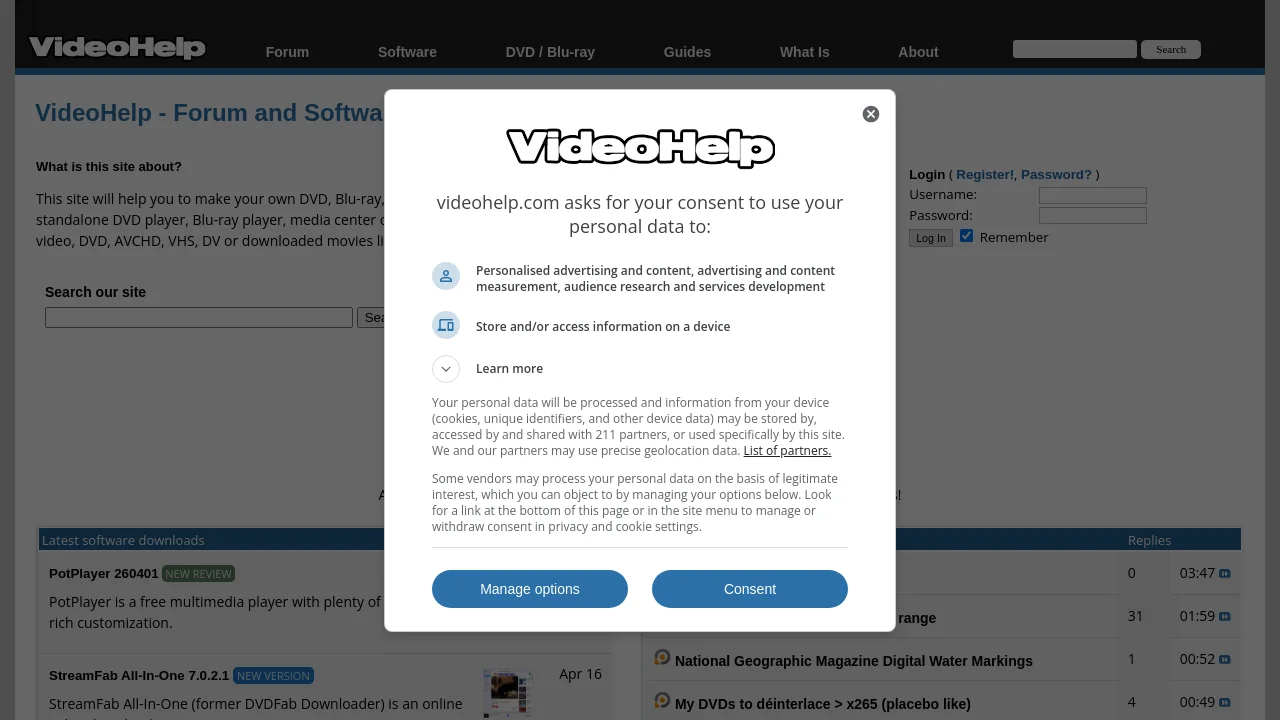
| Title: | VideoHelp - Forum and Software downloads |
| Description: | Video forums, video software downloads, guides, blu-ray players and media. |
| ip_address | 81.171.6.66 |
| country | NL  |
| network_name | Leaseweb Netherlands B.V. |
| asn | AS60781 |
21/tcp | ftp | vsftpd 3.0.3 |
80/tcp | http | Apache httpd 2.4.37 |
443/tcp | https | Apache httpd 2.4.37 |
| Software / Version | Category |
|---|---|
| CentOS | Operating systems |
| Funding Choices | Cookie compliance |
| Google Font API | Font scripts |
| Apache HTTP Server 2.4.37 | Web servers |
| jQuery 1.8.0 | JavaScript libraries |
| MySQL | Databases |
| OpenSSL 1.1.1k | Web server extensions |
| PHP 5.6.40 | Programming languages |
| WordPress | CMS, Blogs |
| Google AdSense | Advertising |
| reCAPTCHA | Security |
| Google Tag Manager | Tag managers |
| HSTS | Security |
| RSS | Miscellaneous |
Web Application Vulnerabilities
Evidence
| CVE | CVSS | EPSS Score | EPSS Percentile | Summary |
|---|---|---|---|---|
| CVE-2019-9641 | 9.8 | 0.52083 | 0.97924 | An issue was discovered in the EXIF component in PHP before 7.1.27, 7.2.x before 7.2.16, and 7.3.x before 7.3.3. There is an uninitialized read in exif_process_IFD_in_TIFF. |
| CVE-2017-9225 | 9.8 | 0.00288 | 0.52302 | An issue was discovered in Oniguruma 6.2.0, as used in Oniguruma-mod in Ruby through 2.4.1 and mbstring in PHP through 7.1.5. A stack out-of-bounds write in onigenc_unicode_get_case_fold_codes_by_str() occurs during regular expression compilation. Code point 0xFFFFFFFF is not properly handled in unicode_unfold_key(). A malformed regular expression could result in 4 bytes being written off the end of a stack buffer of expand_case_fold_string() during the call to onigenc_unicode_get_case_fold_codes_by_str(), a typical stack buffer overflow. |
| CVE-2017-8923 | 9.8 | 0.04586 | 0.8924 | The zend_string_extend function in Zend/zend_string.h in PHP through 7.1.5 does not prevent changes to string objects that result in a negative length, which allows remote attackers to cause a denial of service (application crash) or possibly have unspecified other impact by leveraging a script's use of .= with a long string. |
| CVE-2019-9639 | 7.5 | 0.14536 | 0.94472 | An issue was discovered in the EXIF component in PHP before 7.1.27, 7.2.x before 7.2.16, and 7.3.x before 7.3.3. There is an uninitialized read in exif_process_IFD_in_MAKERNOTE because of mishandling the data_len variable. |
| CVE-2019-9638 | 7.5 | 0.15914 | 0.94767 | An issue was discovered in the EXIF component in PHP before 7.1.27, 7.2.x before 7.2.16, and 7.3.x before 7.3.3. There is an uninitialized read in exif_process_IFD_in_MAKERNOTE because of mishandling the maker_note->offset relationship to value_len. |
Vulnerability description
Outdated or vulnerable software components include versions of server-side software that are no longer supported or have known, publicly disclosed vulnerabilities. Using outdated software significantly increases the attack surface of a system and may allow unauthorized access, data leaks, or service disruptions. Vulnerabilities in these components are often well-documented and actively exploited by attackers. Without security patches or vendor support, any weaknesses remain unmitigated, exposing the application to risks. In some cases, even after patching, the reported version may remain unchanged, requiring manual verification.
Risk description
The risk is that an attacker could search for an appropriate exploit (or create one himself) for any of these vulnerabilities and use it to attack the system. Since the vulnerabilities were discovered using only version-based testing, the risk level for this finding will not exceed 'high' severity. Critical risks will be assigned to vulnerabilities identified through accurate active testing methods.
Recommendation
In order to eliminate the risk of these vulnerabilities, we recommend you check the installed software version and upgrade to the latest version.
Classification
| CWE | CWE-1035 |
| OWASP Top 10 - 2017 | |
| OWASP Top 10 - 2021 |
Evidence
| URL | Cookie Name | Evidence |
|---|---|---|
| https://www.videohelp.com/ | listlastvisitnew | The server responded with Set-Cookie header(s) that does not specify the HttpOnly flag: Set-Cookie: listlastvisitnew=%7B%22indextools%22%3A%7B%22lastvisit%22%3A1776396142%2C%22lastactivity%22%3A1776396142%7D%7D |
Vulnerability description
We found that a cookie has been set without the HttpOnly flag, which means it can be accessed by potentially malicious JavaScript code running inside the web page. The root cause for this usually revolves around misconfigurations in the code or server settings.
Risk description
The risk is that an attacker who injects malicious JavaScript code on the page (e.g. by using an XSS attack) can access the cookie and can send it to another site. In case of a session cookie, this could lead to session hijacking.
Recommendation
Ensure that the HttpOnly flag is set for all cookies.
Classification
| CWE | CWE-1004 |
| OWASP Top 10 - 2017 | |
| OWASP Top 10 - 2021 |
Evidence
| CVE | CVSS | EPSS Score | EPSS Percentile | Summary |
|---|---|---|---|---|
| CVE-2020-11023 | 6.9 | 0.42137 | 0.9745 | In jQuery versions greater than or equal to 1.0.3 and before 3.5.0, passing HTML containing <option> elements from untrusted sources - even after sanitizing it - to one of jQuery's DOM manipulation methods (i.e. .html(), .append(), and others) may execute untrusted code. This problem is patched in jQuery 3.5.0. |
| CVE-2020-11022 | 6.9 | 0.03538 | 0.87688 | In jQuery starting with 1.12.0 and before 3.5.0, passing HTML from untrusted sources - even after sanitizing it - to one of jQuery's DOM manipulation methods (i.e. .html(), .append(), and others) may execute untrusted code. This problem is patched in jQuery 3.5.0. |
| CVE-2020-7656 | 6.1 | 0.01105 | 0.78125 | jquery prior to 1.9.0 allows Cross-site Scripting attacks via the load method. The load method fails to recognize and remove "<script>" HTML tags that contain a whitespace character, i.e: "</script >", which results in the enclosed script logic to be executed. |
| CVE-2019-11358 | 6.1 | 0.02646 | 0.85754 | jQuery before 3.4.0, as used in Drupal, Backdrop CMS, and other products, mishandles jQuery.extend(true, {}, ...) because of Object.prototype pollution. If an unsanitized source object contained an enumerable __proto__ property, it could extend the native Object.prototype. |
| CVE-2015-9251 | 6.1 | 0.27164 | 0.96392 | jQuery before 3.0.0 is vulnerable to Cross-site Scripting (XSS) attacks when a cross-domain Ajax request is performed without the dataType option, causing text/javascript responses to be executed. |
Vulnerability description
Outdated or vulnerable software components include versions of server-side software that are no longer supported or have known, publicly disclosed vulnerabilities. Using outdated software significantly increases the attack surface of a system and may allow unauthorized access, data leaks, or service disruptions. Vulnerabilities in these components are often well-documented and actively exploited by attackers. Without security patches or vendor support, any weaknesses remain unmitigated, exposing the application to risks. In some cases, even after patching, the reported version may remain unchanged, requiring manual verification.
Risk description
The risk is that an attacker could search for an appropriate exploit (or create one himself) for any of these vulnerabilities and use it to attack the system. Since the vulnerabilities were discovered using only version-based testing, the risk level for this finding will not exceed 'high' severity. Critical risks will be assigned to vulnerabilities identified through accurate active testing methods.
Recommendation
In order to eliminate the risk of these vulnerabilities, we recommend you check the installed software version and upgrade to the latest version.
Classification
| CWE | CWE-1035 |
| OWASP Top 10 - 2017 | |
| OWASP Top 10 - 2021 |
Evidence
| URL | Evidence |
|---|---|
| https://www.videohelp.com/forum | Response headers include the HTTP Content-Security-Policy security header with the following security issues: |
Vulnerability description
We noticed that the Content-Security-Policy (CSP) header configured for the web application includes unsafe directives. The CSP header activates a protection mechanism implemented in web browsers which prevents exploitation of Cross-Site Scripting vulnerabilities (XSS) by restricting the sources from which content can be loaded or executed.
Risk description
For example, if the unsafe-inline directive is present in the CSP header, the execution of inline scripts and event handlers is allowed. This can be exploited by an attacker to execute arbitrary JavaScript code in the context of the vulnerable application.
Recommendation
Remove the unsafe values from the directives, adopt nonces or hashes for safer inclusion of inline scripts if they are needed, and explicitly define the sources from which scripts, styles, images or other resources can be loaded.
Classification
| CWE | CWE-1021 |
| OWASP Top 10 - 2017 | |
| OWASP Top 10 - 2021 |
Evidence
| URL | Method | Summary |
|---|---|---|
| https://www.videohelp.com/?canary=jhebmfpikj | TRACE | We injected a random query parameter inside a HTTP TRACE request. The server responded with a 200 OK HTTP status code and we found the random value reflected in the body of the response. |
Vulnerability description
We have noticed that the webserver responded with a 200 OK HTTP status when a TRACE/TRACK HTTP request was sent. Originally intended for debugging purposes, these methods respond to requests by echoing back the contents of the request received.
Risk description
The only risk this might present nowadays is revealing HTTP headers that have been appended by intermediate proxy servers on the way to the destination. This can present a danger if any of those headers contain sensitive information like authentication information, secret keys.
Recommendation
Generally, it is good practice to disable unused functionality to minimize your attack surface. We recommend that you disable unused HTTP methods, or even better, allow only the ones that you know are used. This can be done using your webserver configuration.
Classification
| CWE | CWE-16 |
| OWASP Top 10 - 2017 | |
| OWASP Top 10 - 2021 |
Evidence
| Software / Version | Category |
|---|---|
| CentOS | Operating systems |
| Funding Choices | Cookie compliance |
| Google Font API | Font scripts |
| Apache HTTP Server 2.4.37 | Web servers |
| jQuery 1.8.0 | JavaScript libraries |
| MySQL | Databases |
| OpenSSL 1.1.1k | Web server extensions |
| PHP 5.6.40 | Programming languages |
| WordPress | CMS, Blogs |
| Google AdSense | Advertising |
| reCAPTCHA | Security |
| Google Tag Manager | Tag managers |
| HSTS | Security |
| RSS | Miscellaneous |
Vulnerability description
We noticed that server software and technology details are exposed, potentially aiding attackers in tailoring specific exploits against identified systems and versions.
Risk description
The risk is that an attacker could use this information to mount specific attacks against the identified software type and version.
Recommendation
We recommend you to eliminate the information which permits the identification of software platform, technology, server and operating system: HTTP server headers, HTML meta information, etc.
Classification
| CWE | CWE-200 |
| OWASP Top 10 - 2017 | |
| OWASP Top 10 - 2021 |
Evidence
| URL | Evidence |
|---|---|
| https://www.videohelp.com/ | Response headers do not include the X-Content-Type-Options HTTP security header |
Vulnerability description
We noticed that the target application's server responses lack the X-Content-Type-Options header. This header is particularly important for preventing Internet Explorer from reinterpreting the content of a web page (MIME-sniffing) and thus overriding the value of the Content-Type header.
Risk description
The risk is that lack of this header could make possible attacks such as Cross-Site Scripting or phishing in Internet Explorer browsers.
Recommendation
We recommend setting the X-Content-Type-Options header such as `X-Content-Type-Options: nosniff`.
Classification
| CWE | CWE-693 |
| OWASP Top 10 - 2017 | |
| OWASP Top 10 - 2021 |
Evidence
Vulnerability description
We found the robots.txt on the target server. This file instructs web crawlers what URLs and endpoints of the web application they can visit and crawl. Website administrators often misuse this file while attempting to hide some web pages from the users.
Risk description
There is no particular security risk in having a robots.txt file. However, it's important to note that adding endpoints in it should not be considered a security measure, as this file can be directly accessed and read by anyone.
Recommendation
We recommend you to manually review the entries from robots.txt and remove the ones which lead to sensitive locations in the website (ex. administration panels, configuration files, etc).
Evidence
| URL | Evidence |
|---|---|
| https://www.videohelp.com/ | Response does not include the HTTP Content-Security-Policy security header or meta tag |
Vulnerability description
We noticed that the target application lacks the Content-Security-Policy (CSP) header in its HTTP responses. The CSP header is a security measure that instructs web browsers to enforce specific security rules, effectively preventing the exploitation of Cross-Site Scripting (XSS) vulnerabilities.
Risk description
The risk is that if the target application is vulnerable to XSS, lack of this header makes it easily exploitable by attackers.
Recommendation
Configure the Content-Security-Header to be sent with each HTTP response in order to apply the specific policies needed by the application.
Classification
| CWE | CWE-1021 |
| OWASP Top 10 - 2017 | |
| OWASP Top 10 - 2021 |
Evidence
| URL | Method | Parameters | Evidence |
|---|---|---|---|
| https://www.videohelp.com/ | GET | Headers: User-Agent=Mozilla/5.0 (Windows NT 10.0; Win64; x64) AppleWebKit/537.36 (KHTML, like Gecko) Chrome/108.0.0.0 Safari/537.36 | Email Address: support@videohelp.com |
Vulnerability description
We noticed that this web application exposes email addresses, which might be unintended. While not inherently a vulnerability, this information could be leveraged in social engineering or spam related activities.
Risk description
The risk is that exposed email addresses within the application could be accessed by unauthorized parties. This could lead to privacy violations, spam, phishing attacks, or other forms of misuse.
Recommendation
Compartmentalize the application to have 'safe' areas where trust boundaries can be unambiguously drawn. Do not allow email addresses to go outside of the trust boundary, and always be careful when interfacing with a compartment outside of the safe area.
Classification
| CWE | CWE-200 |
| OWASP Top 10 - 2017 | |
| OWASP Top 10 - 2021 |
Infrastructure Vulnerabilities
Evidence
| CVE | CVSS | EPSS Score | EPSS Percentile | CISA KEV | Summary |
|---|---|---|---|---|---|
| CVE-2021-30047 | 7.5 | 0.3126 | 0.96771 | No | VSFTPD 3.0.3 allows attackers to cause a denial of service due to limited number of connections allowed. |
| CVE-2021-3618 | 7.4 | 0.00615 | 0.69937 | No | ALPACA is an application layer protocol content confusion attack, exploiting TLS servers implementing different protocols but using compatible certificates, such as multi-domain or wildcard certificates. A MiTM attacker having access to victim's traffic at the TCP/IP layer can redirect traffic from one subdomain to another, resulting in a valid TLS session. This breaks the authentication of TLS and cross-protocol attacks may be possible where the behavior of one protocol service may compromise the other at the application layer. |
Vulnerability description
Vulnerabilities found for Vsftpd 3.0.3
Risk description
These vulnerabilities expose the affected applications to the risk of unauthorized access to confidential data and possibly to denial of service attacks. An attacker could search for an appropriate exploit (or create one) for any of these vulnerabilities and use it to attack the system. Notes: - The vulnerabilities are identified based on the server's version.; - Only the first 5 vulnerabilities with the highest risk are shown for each port.; Since the vulnerabilities were discovered using only version-based testing, the risk level for this finding will not exceed "high" severity. Critical risks will be assigned to vulnerabilities identified through accurate active testing methods.
Recommendation
We recommend you to upgrade the affected software to the latest version in order to eliminate the risks imposed by these vulnerabilities.
Evidence
| CVE | CVSS | EPSS Score | EPSS Percentile | CISA KEV | Summary |
|---|---|---|---|---|---|
| CVE-2019-9641 | 9.8 | 0.52083 | 0.97924 | No | An issue was discovered in the EXIF component in PHP before 7.1.27, 7.2.x before 7.2.16, and 7.3.x before 7.3.3. There is an uninitialized read in exif_process_IFD_in_TIFF. |
| CVE-2017-9225 | 9.8 | 0.00288 | 0.52302 | No | An issue was discovered in Oniguruma 6.2.0, as used in Oniguruma-mod in Ruby through 2.4.1 and mbstring in PHP through 7.1.5. A stack out-of-bounds write in onigenc_unicode_get_case_fold_codes_by_str() occurs during regular expression compilation. Code point 0xFFFFFFFF is not properly handled in unicode_unfold_key(). A malformed regular expression could result in 4 bytes being written off the end of a stack buffer of expand_case_fold_string() during the call to onigenc_unicode_get_case_fold_codes_by_str(), a typical stack buffer overflow. |
| CVE-2017-8923 | 9.8 | 0.04586 | 0.8924 | No | The zend_string_extend function in Zend/zend_string.h in PHP through 7.1.5 does not prevent changes to string objects that result in a negative length, which allows remote attackers to cause a denial of service (application crash) or possibly have unspecified other impact by leveraging a script's use of .= with a long string. |
| CVE-2019-9639 | 7.5 | 0.14536 | 0.94472 | No | An issue was discovered in the EXIF component in PHP before 7.1.27, 7.2.x before 7.2.16, and 7.3.x before 7.3.3. There is an uninitialized read in exif_process_IFD_in_MAKERNOTE because of mishandling the data_len variable. |
| CVE-2019-9638 | 7.5 | 0.15914 | 0.94767 | No | An issue was discovered in the EXIF component in PHP before 7.1.27, 7.2.x before 7.2.16, and 7.3.x before 7.3.3. There is an uninitialized read in exif_process_IFD_in_MAKERNOTE because of mishandling the maker_note->offset relationship to value_len. |
Vulnerability description
Vulnerabilities found for PHP 5.6.40
Risk description
These vulnerabilities expose the affected applications to the risk of unauthorized access to confidential data and possibly to denial of service attacks. An attacker could search for an appropriate exploit (or create one) for any of these vulnerabilities and use it to attack the system. Notes: - The vulnerabilities are identified based on the server's version.; - Only the first 5 vulnerabilities with the highest risk are shown for each port.; Since the vulnerabilities were discovered using only version-based testing, the risk level for this finding will not exceed "high" severity. Critical risks will be assigned to vulnerabilities identified through accurate active testing methods.
Recommendation
We recommend you to upgrade the affected software to the latest version in order to eliminate the risks imposed by these vulnerabilities.
Evidence
| CVE | CVSS | EPSS Score | EPSS Percentile | CISA KEV | Summary |
|---|---|---|---|---|---|
| CVE-2021-3711 | 9.8 | 0.02544 | 0.85495 | No | In order to decrypt SM2 encrypted data an application is expected to call the API function EVP_PKEY_decrypt(). Typically an application will call this function twice. The first time, on entry, the "out" parameter can be NULL and, on exit, the "outlen" parameter is populated with the buffer size required to hold the decrypted plaintext. The application can then allocate a sufficiently sized buffer and call EVP_PKEY_decrypt() again, but this time passing a non-NULL value for the "out" parameter. A bug in the implementation of the SM2 decryption code means that the calculation of the buffer size required to hold the plaintext returned by the first call to EVP_PKEY_decrypt() can be smaller than the actual size required by the second call. This can lead to a buffer overflow when EVP_PKEY_decrypt() is called by the application a second time with a buffer that is too small. A malicious attacker who is able present SM2 content for decryption to an application could cause attacker chosen data to overflow the buffer by up to a maximum of 62 bytes altering the contents of other data held after the buffer, possibly changing application behaviour or causing the application to crash. The location of the buffer is application dependent but is typically heap allocated. Fixed in OpenSSL 1.1.1l (Affected 1.1.1-1.1.1k). |
| CVE-2023-4807 | 7.8 | 0.0082 | 0.74416 | No | Issue summary: The POLY1305 MAC (message authentication code) implementation contains a bug that might corrupt the internal state of applications on the Windows 64 platform when running on newer X86_64 processors supporting the AVX512-IFMA instructions. Impact summary: If in an application that uses the OpenSSL library an attacker can influence whether the POLY1305 MAC algorithm is used, the application state might be corrupted with various application dependent consequences. The POLY1305 MAC (message authentication code) implementation in OpenSSL does not save the contents of non-volatile XMM registers on Windows 64 platform when calculating the MAC of data larger than 64 bytes. Before returning to the caller all the XMM registers are set to zero rather than restoring their previous content. The vulnerable code is used only on newer x86_64 processors supporting the AVX512-IFMA instructions. The consequences of this kind of internal application state corruption can be various - from no consequences, if the calling application does not depend on the contents of non-volatile XMM registers at all, to the worst consequences, where the attacker could get complete control of the application process. However given the contents of the registers are just zeroized so the attacker cannot put arbitrary values inside, the most likely consequence, if any, would be an incorrect result of some application dependent calculations or a crash leading to a denial of service. The POLY1305 MAC algorithm is most frequently used as part of the CHACHA20-POLY1305 AEAD (authenticated encryption with associated data) algorithm. The most common usage of this AEAD cipher is with TLS protocol versions 1.2 and 1.3 and a malicious client can influence whether this AEAD cipher is used by the server. This implies that server applications using OpenSSL can be potentially impacted. However we are currently not aware of any concrete application that would be affected by this issue therefore we consider this a Low severity security issue. As a workaround the AVX512-IFMA instructions support can be disabled at runtime by setting the environment variable OPENSSL_ia32cap: OPENSSL_ia32cap=:~0x200000 The FIPS provider is not affected by this issue. |
| CVE-2025-69421 | 7.5 | 0.00036 | 0.10409 | No | Issue summary: Processing a malformed PKCS#12 file can trigger a NULL pointer dereference in the PKCS12_item_decrypt_d2i_ex() function. Impact summary: A NULL pointer dereference can trigger a crash which leads to Denial of Service for an application processing PKCS#12 files. The PKCS12_item_decrypt_d2i_ex() function does not check whether the oct parameter is NULL before dereferencing it. When called from PKCS12_unpack_p7encdata() with a malformed PKCS#12 file, this parameter can be NULL, causing a crash. The vulnerability is limited to Denial of Service and cannot be escalated to achieve code execution or memory disclosure. Exploiting this issue requires an attacker to provide a malformed PKCS#12 file to an application that processes it. For that reason the issue was assessed as Low severity according to our Security Policy. The FIPS modules in 3.6, 3.5, 3.4, 3.3 and 3.0 are not affected by this issue, as the PKCS#12 implementation is outside the OpenSSL FIPS module boundary. OpenSSL 3.6, 3.5, 3.4, 3.3, 3.0, 1.1.1 and 1.0.2 are vulnerable to this issue. |
| CVE-2025-69420 | 7.5 | 0.00303 | 0.53612 | No | Issue summary: A type confusion vulnerability exists in the TimeStamp Response verification code where an ASN1_TYPE union member is accessed without first validating the type, causing an invalid or NULL pointer dereference when processing a malformed TimeStamp Response file. Impact summary: An application calling TS_RESP_verify_response() with a malformed TimeStamp Response can be caused to dereference an invalid or NULL pointer when reading, resulting in a Denial of Service. The functions ossl_ess_get_signing_cert() and ossl_ess_get_signing_cert_v2() access the signing cert attribute value without validating its type. When the type is not V_ASN1_SEQUENCE, this results in accessing invalid memory through the ASN1_TYPE union, causing a crash. Exploiting this vulnerability requires an attacker to provide a malformed TimeStamp Response to an application that verifies timestamp responses. The TimeStamp protocol (RFC 3161) is not widely used and the impact of the exploit is just a Denial of Service. For these reasons the issue was assessed as Low severity. The FIPS modules in 3.5, 3.4, 3.3 and 3.0 are not affected by this issue, as the TimeStamp Response implementation is outside the OpenSSL FIPS module boundary. OpenSSL 3.6, 3.5, 3.4, 3.3, 3.0 and 1.1.1 are vulnerable to this issue. OpenSSL 1.0.2 is not affected by this issue. |
| CVE-2023-0464 | 7.5 | 0.00968 | 0.76635 | No | A security vulnerability has been identified in all supported versions of OpenSSL related to the verification of X.509 certificate chains that include policy constraints. Attackers may be able to exploit this vulnerability by creating a malicious certificate chain that triggers exponential use of computational resources, leading to a denial-of-service (DoS) attack on affected systems. Policy processing is disabled by default but can be enabled by passing the `-policy' argument to the command line utilities or by calling the `X509_VERIFY_PARAM_set1_policies()' function. |
Vulnerability description
Vulnerabilities found for OpenSSL 1.1.1k
Risk description
These vulnerabilities expose the affected applications to the risk of unauthorized access to confidential data and possibly to denial of service attacks. An attacker could search for an appropriate exploit (or create one) for any of these vulnerabilities and use it to attack the system. Notes: - The vulnerabilities are identified based on the server's version.; - Only the first 5 vulnerabilities with the highest risk are shown for each port.; Since the vulnerabilities were discovered using only version-based testing, the risk level for this finding will not exceed "high" severity. Critical risks will be assigned to vulnerabilities identified through accurate active testing methods.
Recommendation
We recommend you to upgrade the affected software to the latest version in order to eliminate the risks imposed by these vulnerabilities.
Evidence
| CVE | CVSS | EPSS Score | EPSS Percentile | CISA KEV | Summary |
|---|---|---|---|---|---|
| CVE-2024-38476 | 9.8 | 0.04554 | 0.89205 | No | Vulnerability in core of Apache HTTP Server 2.4.59 and earlier are vulnerably to information disclosure, SSRF or local script execution via backend applications whose response headers are malicious or exploitable. Users are recommended to upgrade to version 2.4.60, which fixes this issue. |
| CVE-2024-38474 | 9.8 | 0.00994 | 0.76966 | No | Substitution encoding issue in mod_rewrite in Apache HTTP Server 2.4.59 and earlier allows attacker to execute scripts in directories permitted by the configuration but not directly reachable by any URL or source disclosure of scripts meant to only to be executed as CGI. Users are recommended to upgrade to version 2.4.60, which fixes this issue. Some RewriteRules that capture and substitute unsafely will now fail unless rewrite flag "UnsafeAllow3F" is specified. |
| CVE-2023-25690 | 9.8 | 0.68183 | 0.98605 | No | Some mod_proxy configurations on Apache HTTP Server versions 2.4.0 through 2.4.55 allow a HTTP Request Smuggling attack. Configurations are affected when mod_proxy is enabled along with some form of RewriteRule or ProxyPassMatch in which a non-specific pattern matches some portion of the user-supplied request-target (URL) data and is then re-inserted into the proxied request-target using variable substitution. For example, something like: RewriteEngine on RewriteRule "^/here/(.*)" "http://example.com:8080/elsewhere?$1"; [P] ProxyPassReverse /here/ http://example.com:8080/ Request splitting/smuggling could result in bypass of access controls in the proxy server, proxying unintended URLs to existing origin servers, and cache poisoning. Users are recommended to update to at least version 2.4.56 of Apache HTTP Server. |
| CVE-2022-31813 | 9.8 | 0.00043 | 0.13161 | No | Apache HTTP Server 2.4.53 and earlier may not send the X-Forwarded-* headers to the origin server based on client side Connection header hop-by-hop mechanism. This may be used to bypass IP based authentication on the origin server/application. |
| CVE-2022-23943 | 9.8 | 0.60552 | 0.98291 | No | Out-of-bounds Write vulnerability in mod_sed of Apache HTTP Server allows an attacker to overwrite heap memory with possibly attacker provided data. This issue affects Apache HTTP Server 2.4 version 2.4.52 and prior versions. |
Vulnerability description
Vulnerabilities found for Apache HTTP Server 2.4.37
Risk description
These vulnerabilities expose the affected applications to the risk of unauthorized access to confidential data and possibly to denial of service attacks. An attacker could search for an appropriate exploit (or create one) for any of these vulnerabilities and use it to attack the system. Notes: - The vulnerabilities are identified based on the server's version.; - Only the first 5 vulnerabilities with the highest risk are shown for each port.; Since the vulnerabilities were discovered using only version-based testing, the risk level for this finding will not exceed "high" severity. Critical risks will be assigned to vulnerabilities identified through accurate active testing methods.
Recommendation
We recommend you to upgrade the affected software to the latest version in order to eliminate the risks imposed by these vulnerabilities.
Evidence
We managed to detect that OpenSSL has reached the End-of-Life (EOL).
Version detected: 1.1.1k End-of-life date: 2023-09-11 Latest version for the cycle: 1.1.1w This release cycle (1.1.1) does have long-term-support (LTS). The cycle was released on 2018-09-11 and its latest release date was 2023-09-12.
Risk description
Using end-of-life (EOL) software poses significant security risks for organizations. EOL software no longer receives updates, including critical security patches. This creates a vulnerability landscape where known and potentially new security flaws remain unaddressed, making the software an attractive target for malicious actors. Attackers can exploit these vulnerabilities to gain unauthorized access, disrupt services, or steal sensitive data. Moreover, without updates, compatibility issues arise with newer technologies, leading to operational inefficiencies and increased potential for system failures. Additionally, regulatory and compliance risks accompany the use of EOL software. Many industries have strict data protection regulations that require up-to-date software to ensure the highest security standards. Non-compliance can result in hefty fines and legal consequences. Organizations also risk damaging their reputation if a breach occurs due to outdated software, eroding customer trust and potentially leading to a loss of business. Therefore, continuing to use EOL software undermines both security posture and business integrity, necessitating timely upgrades and proactive risk management strategies.
Recommendation
To mitigate the risks associated with end-of-life (EOL) software, it's crucial to take proactive steps. Start by identifying any EOL software currently in use within your organization. Once identified, prioritize upgrading or replacing these applications with supported versions that receive regular updates and security patches. This not only helps close security gaps but also ensures better compatibility with newer technologies, enhancing overall system efficiency and reliability.Additionally, develop a comprehensive software lifecycle management plan. This plan should include regular audits to identify upcoming EOL dates and a schedule for timely updates or replacements. Train your IT staff and users about the importance of keeping software up to date and the risks associated with using outdated versions. By maintaining a proactive approach to software management, you can significantly reduce security risks, ensure compliance with industry regulations, and protect your organization's reputation and customer trust.
Evidence
We managed to detect that PHP has reached the End-of-Life (EOL).
Version detected: 5.6.40 End-of-life date: 2018-12-31 Latest version for the cycle: 5.6.40 This release cycle (5.6) doesn't have long-term-support (LTS). The cycle was released on 2014-08-28 and its latest release date was 2019-01-10. The support ended on 2017-01-19.
Risk description
Using end-of-life (EOL) software poses significant security risks for organizations. EOL software no longer receives updates, including critical security patches. This creates a vulnerability landscape where known and potentially new security flaws remain unaddressed, making the software an attractive target for malicious actors. Attackers can exploit these vulnerabilities to gain unauthorized access, disrupt services, or steal sensitive data. Moreover, without updates, compatibility issues arise with newer technologies, leading to operational inefficiencies and increased potential for system failures. Additionally, regulatory and compliance risks accompany the use of EOL software. Many industries have strict data protection regulations that require up-to-date software to ensure the highest security standards. Non-compliance can result in hefty fines and legal consequences. Organizations also risk damaging their reputation if a breach occurs due to outdated software, eroding customer trust and potentially leading to a loss of business. Therefore, continuing to use EOL software undermines both security posture and business integrity, necessitating timely upgrades and proactive risk management strategies.
Recommendation
To mitigate the risks associated with end-of-life (EOL) software, it's crucial to take proactive steps. Start by identifying any EOL software currently in use within your organization. Once identified, prioritize upgrading or replacing these applications with supported versions that receive regular updates and security patches. This not only helps close security gaps but also ensures better compatibility with newer technologies, enhancing overall system efficiency and reliability.Additionally, develop a comprehensive software lifecycle management plan. This plan should include regular audits to identify upcoming EOL dates and a schedule for timely updates or replacements. Train your IT staff and users about the importance of keeping software up to date and the risks associated with using outdated versions. By maintaining a proactive approach to software management, you can significantly reduce security risks, ensure compliance with industry regulations, and protect your organization's reputation and customer trust.
Evidence
We managed to detect a publicly accessible File Transfer Protocol (FTP) service. PORT STATE SERVICE VERSION 21/tcp open ftp vsftpd 3.0.3
Vulnerability description
We found that the File Transfer Protocol (FTP) service is publicly accessible. The FTP enables client systems to connect to upload and download files. Nonetheless, FTP lacks encryption for the data exchanged between the server and the client, leaving all transferred data exposed in plaintext.
Risk description
Exposing this service online can enable attackers to execute man-in-the-middle attacks, capturing sensitive user credentials and the contents of files because FTP operates without encryption. The entirety of the communication between the client and the server remains unsecured in plaintext. This acquired information could further facilitate additional attacks within the network.
Recommendation
We recommend turning off FTP access over the Internet and instead using a Virtual Private Network (VPN) that mandates two-factor authentication (2FA). If the FTP service is essential for business purposes, we recommend limiting access only from designated IP addresses using a firewall. Furthermore, utilizing SFTP (Secure File Transfer Protocol) is recommended as this protocol employs encryption to secure data transfers.
Evidence
| Domain Queried | DNS Record Type | Description | Value |
|---|---|---|---|
| www.videohelp.com | A | IPv4 address | 81.171.6.66 |
Risk description
An initial step for an attacker aiming to learn about an organization involves conducting searches on its domain names to uncover DNS records associated with the organization. This strategy aims to amass comprehensive insights into the target domain, enabling the attacker to outline the organization's external digital landscape. This gathered intelligence may subsequently serve as a foundation for launching attacks, including those based on social engineering techniques. DNS records pointing to services or servers that are no longer in use can provide an attacker with an easy entry point into the network.
Recommendation
We recommend reviewing all DNS records associated with the domain and identifying and removing unused or obsolete records.
Evidence
| Operating System | Accuracy |
|---|---|
| Linux 3.10 - 4.11 | 100% |
Vulnerability description
OS Detection
Evidence
| Software / Version | Category |
|---|---|
| WordPress | CMS, Blogs |
| MySQL | Databases |
| PHP 5.6.40 | Programming languages |
| CentOS | Operating systems |
| OpenSSL 1.1.1k | Web server extensions |
| Apache HTTP Server 2.4.37 | Web servers |
| Google AdSense | Advertising |
| Funding Choices | Cookie compliance |
| jQuery | JavaScript libraries |
| reCAPTCHA | Security |
| HSTS | Security |
Vulnerability description
We noticed that server software and technology details are exposed, potentially aiding attackers in tailoring specific exploits against identified systems and versions.
Risk description
The risk is that an attacker could use this information to mount specific attacks against the identified software type and version.
Recommendation
We recommend you to eliminate the information which permits the identification of software platform, technology, server and operating system: HTTP server headers, HTML meta information, etc.