Vulnerability Scan Result

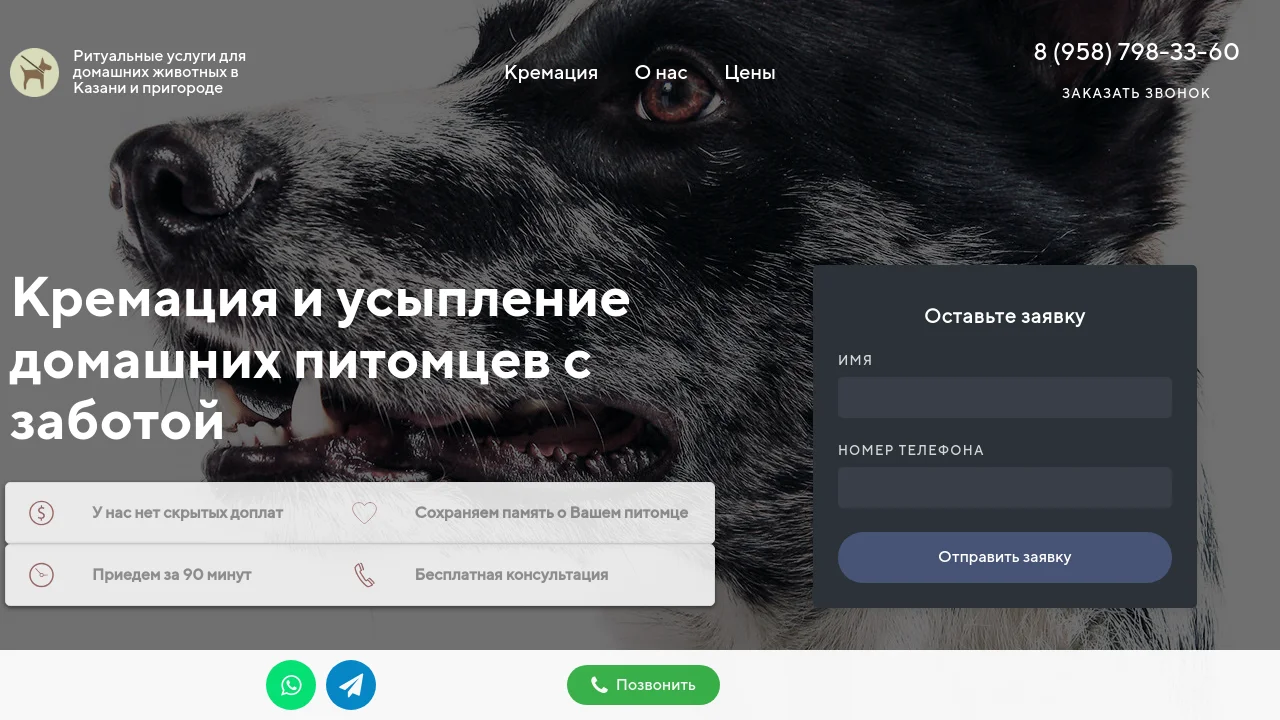
| Title: | Усыпление и кремация домашних животных в Казани |
| Description: | Кремация, усыпление (эвтаназия) домашних животных в Казани. Индивидуальная и общая кремация. С вывозом. |
| ip_address | 85.119.149.96 |
| country | RU  |
| network_name | JSC Selectel |
| asn | AS50340 |
22/tcp | ssh | OpenSSH 9.6p1 Ubuntu 3ubuntu13.16 |
80/tcp | http | - - |
443/tcp | https | - - |
No technologies could be detected.
Web Application Vulnerabilities
No vulnerabilities were found.
Infrastructure Vulnerabilities
Evidence
We managed to detect a publicly accessible SSH service. Starting Nmap ( https://nmap.org ) at 2026-05-04 01:17 EEST Nmap scan report for www.kazan.pet-ritualservice.ru (85.119.149.96) Host is up (0.050s latency).
PORT STATE SERVICE VERSION 22/tcp open ssh OpenSSH 9.6p1 Ubuntu 3ubuntu13.16 (Ubuntu Linux; protocol 2.0) | ssh-auth-methods: | Supported authentication methods: | publickey |_ password Service Info: OS: Linux; CPE: cpe:/o:linux:linux_kernel
Service detection performed. Please report any incorrect results at https://nmap.org/submit/ . Nmap done: 1 IP address (1 host up) scanned in 1.63 seconds
Vulnerability description
We found that the SSH service with username/password authentication is publicly accessible. Network administrators often use remote administration protocols to control devices like switches, routers, and other essential systems. However, allowing these services to be accessible via the Internet can increase security risks, creating potential opportunities for attacks on the organization.
Risk description
Exposing this service online with username/password authentication can enable attackers to launch authentication attacks, like guessing login credentials, and potentially gaining unauthorized access. Vulnerabilities, such as unpatched software, protocol flaws, or backdoors could also be exploited. An example is the CVE-2024-3094 (XZ Utils Backdoor) vulnerability.
Recommendation
We recommend turning off SSH with username/password authentication access over the Internet and instead using a Virtual Private Network (VPN) that mandates two-factor authentication (2FA). If the SSH service is essential for business purposes, we recommend limiting access only from designated IP addresses using a firewall. Furthermore, it is advisable to utilize SSH Public Key Authentication since it employs a key pair to verify the identity of a user or process.
Evidence
| CVE | CVSS | EPSS Score | EPSS Percentile | CISA KEV | Summary |
|---|---|---|---|---|---|
| CVE-2020-11023 | 6.9 | 0.66129 | 0.98535 | Yes | In jQuery versions greater than or equal to 1.0.3 and before 3.5.0, passing HTML containing <option> elements from untrusted sources - even after sanitizing it - to one of jQuery's DOM manipulation methods (i.e. .html(), .append(), and others) may execute untrusted code. This problem is patched in jQuery 3.5.0. |
| CVE-2020-11022 | 6.9 | 0.07042 | 0.91527 | No | In jQuery starting with 1.12.0 and before 3.5.0, passing HTML from untrusted sources - even after sanitizing it - to one of jQuery's DOM manipulation methods (i.e. .html(), .append(), and others) may execute untrusted code. This problem is patched in jQuery 3.5.0. |
| CVE-2019-11358 | 6.1 | 0.02426 | 0.85206 | No | jQuery before 3.4.0, as used in Drupal, Backdrop CMS, and other products, mishandles jQuery.extend(true, {}, ...) because of Object.prototype pollution. If an unsanitized source object contained an enumerable __proto__ property, it could extend the native Object.prototype. |
| CVE-2015-9251 | 6.1 | 0.27164 | 0.96407 | No | jQuery before 3.0.0 is vulnerable to Cross-site Scripting (XSS) attacks when a cross-domain Ajax request is performed without the dataType option, causing text/javascript responses to be executed. |
Vulnerability description
Vulnerabilities found for jQuery 1.11.3
Risk description
These vulnerabilities expose the affected applications to the risk of unauthorized access to confidential data and possibly to denial of service attacks. An attacker could search for an appropriate exploit (or create one) for any of these vulnerabilities and use it to attack the system. Notes: - The vulnerabilities are identified based on the server's version.; - Only the first 5 vulnerabilities with the highest risk are shown for each port.; Since the vulnerabilities were discovered using only version-based testing, the risk level for this finding will not exceed "high" severity. Critical risks will be assigned to vulnerabilities identified through accurate active testing methods.
Recommendation
We recommend you to upgrade the affected software to the latest version in order to eliminate the risks imposed by these vulnerabilities.
Evidence
We found insecure DNS cookie usage on the following nameservers: ns1.platformalp.ru
Vulnerability description
We found that the server does not implement DNS Cookies or uses them insecurely. DNS Cookies help prevent DNS-based attacks, such as spoofing and amplification attacks.
Risk description
The risk exists because without DNS Cookies, the server is vulnerable to DNS spoofing and amplification attacks. Attackers can manipulate responses or use the server in distributed denial-of-service (DDoS) attacks, compromising network availability and security.
Recommendation
We recommend enabling DNS Cookies to prevent spoofed DNS responses. Ensure proper cookie validation is implemented to mitigate DNS amplification attacks. Regularly update DNS servers to support the latest DNS security features.
Evidence
We managed to detect that jQuery has reached the End-of-Life (EOL).
Version detected: 1.11.3 Latest version for the cycle: 1.12.4 This release cycle (1) doesn't have long-term-support (LTS). The cycle was released on 2006-08-31 and its latest release date was 2016-05-20.
Risk description
Using end-of-life (EOL) software poses significant security risks for organizations. EOL software no longer receives updates, including critical security patches. This creates a vulnerability landscape where known and potentially new security flaws remain unaddressed, making the software an attractive target for malicious actors. Attackers can exploit these vulnerabilities to gain unauthorized access, disrupt services, or steal sensitive data. Moreover, without updates, compatibility issues arise with newer technologies, leading to operational inefficiencies and increased potential for system failures. Additionally, regulatory and compliance risks accompany the use of EOL software. Many industries have strict data protection regulations that require up-to-date software to ensure the highest security standards. Non-compliance can result in hefty fines and legal consequences. Organizations also risk damaging their reputation if a breach occurs due to outdated software, eroding customer trust and potentially leading to a loss of business. Therefore, continuing to use EOL software undermines both security posture and business integrity, necessitating timely upgrades and proactive risk management strategies.
Recommendation
To mitigate the risks associated with end-of-life (EOL) software, it's crucial to take proactive steps. Start by identifying any EOL software currently in use within your organization. Once identified, prioritize upgrading or replacing these applications with supported versions that receive regular updates and security patches. This not only helps close security gaps but also ensures better compatibility with newer technologies, enhancing overall system efficiency and reliability.Additionally, develop a comprehensive software lifecycle management plan. This plan should include regular audits to identify upcoming EOL dates and a schedule for timely updates or replacements. Train your IT staff and users about the importance of keeping software up to date and the risks associated with using outdated versions. By maintaining a proactive approach to software management, you can significantly reduce security risks, ensure compliance with industry regulations, and protect your organization's reputation and customer trust.
Evidence
| Software / Version | Category |
|---|---|
| WordPress | CMS, Blogs |
| Platforma LP | Page builders |
| MySQL | Databases |
| PHP | Programming languages |
| Yandex.Metrika | Analytics |
| Google Tag Manager | Tag managers |
| jQuery 1.11.3 | JavaScript libraries |
| Google Analytics UA | Analytics |
| DoubleClick Floodlight | Advertising |
Vulnerability description
We noticed that server software and technology details are exposed, potentially aiding attackers in tailoring specific exploits against identified systems and versions.
Risk description
The risk is that an attacker could use this information to mount specific attacks against the identified software type and version.
Recommendation
We recommend you to eliminate the information which permits the identification of software platform, technology, server and operating system: HTTP server headers, HTML meta information, etc.
Evidence
| Domain Queried | DNS Record Type | Description | Value |
|---|---|---|---|
| www.kazan.pet-ritualservice.ru | A | IPv4 address | 85.119.149.96 |
| www.kazan.pet-ritualservice.ru | NS | Name server | ns2.platformalp.ru |
| www.kazan.pet-ritualservice.ru | NS | Name server | ns1.platformalp.ru |
| www.kazan.pet-ritualservice.ru | SOA | Start of Authority | ns1.platformalp.ru. support.cloudns.net. 2024100101 7200 1800 1209600 3600 |
| www.kazan.pet-ritualservice.ru | CNAME | Canonical name | pet-ritualservice.ru |
Risk description
An initial step for an attacker aiming to learn about an organization involves conducting searches on its domain names to uncover DNS records associated with the organization. This strategy aims to amass comprehensive insights into the target domain, enabling the attacker to outline the organization's external digital landscape. This gathered intelligence may subsequently serve as a foundation for launching attacks, including those based on social engineering techniques. DNS records pointing to services or servers that are no longer in use can provide an attacker with an easy entry point into the network.
Recommendation
We recommend reviewing all DNS records associated with the domain and identifying and removing unused or obsolete records.
Evidence
| Operating System | Accuracy |
|---|---|
| Linux 4.15 - 5.6 | 91% |
Vulnerability description
OS Detection