Vulnerability Scan Result

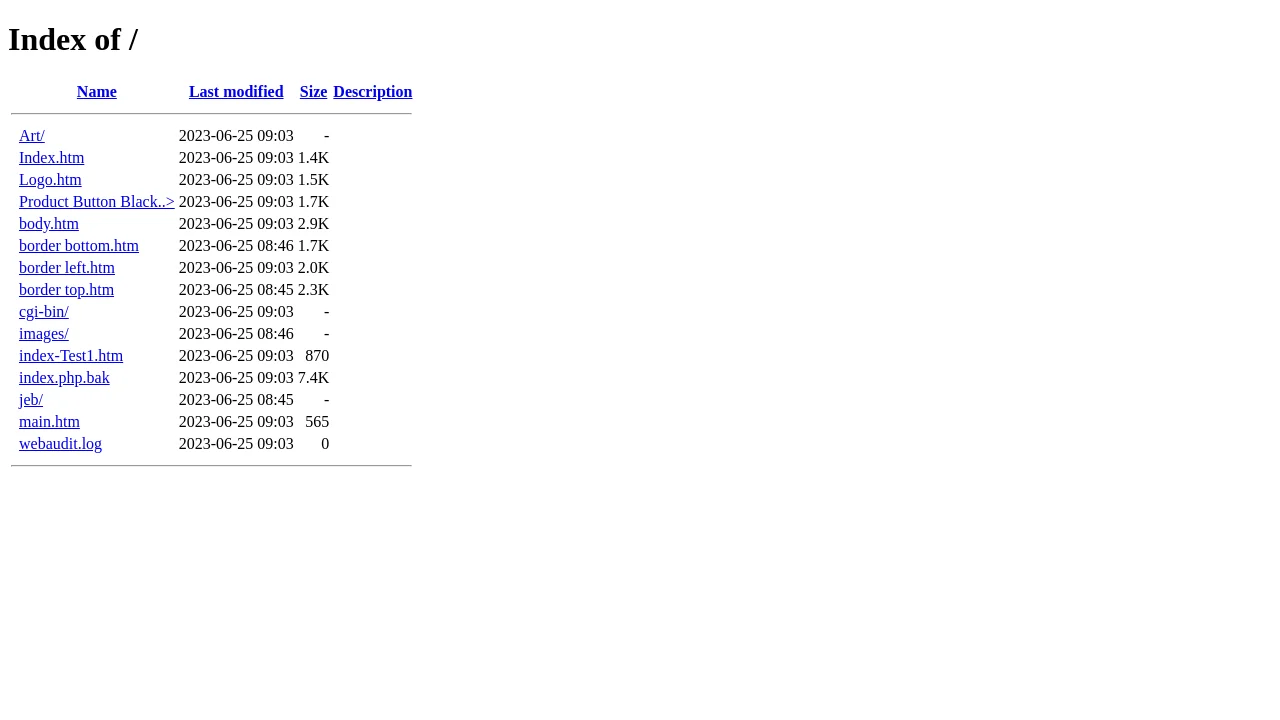
| Title: | Index of / |
| Description: | No description found |
| ip_address | 216.117.188.187 |
| country | US  |
| network_name | Advanced Internet Technologies |
| asn | AS10843 |
21/tcp | ftp | Pure-FTPd - |
25/tcp | smtp | - - |
53/tcp | domain | PowerDNS Authoritative Server 4.9.5 |
80/tcp | http | Apache httpd - |
110/tcp | pop3 | Dovecot pop3d - |
143/tcp | imap | Dovecot imapd - |
443/tcp | https | Apache httpd - |
465/tcp | smtp | Exim smtpd 4.99.1 |
587/tcp | smtp | Exim smtpd 4.99.1 |
993/tcp | imap | Dovecot imapd - |
995/tcp | pop3 | Dovecot pop3d - |
2078/tcp | https | cPanel httpd - |
2080/tcp | https | cPanel httpd - |
2082/tcp | http | OpenResty web app server 1.27.1.1 |
2083/tcp | https | nginx - |
2086/tcp | http | - - |
3306/tcp | mysql | MariaDB - |
| Software / Version | Category |
|---|---|
| Apache HTTP Server | Web servers |
| HSTS | Security |
Web Application Vulnerabilities
Evidence
| URL | Evidence |
|---|---|
| http://www.macdougallblake.com.mb-email.com/ | Found output resembling directory listing. |
Vulnerability description
We noticed that the target application's web server is affected by a Directory Listing vulnerability in its URL structure. Directory listing is enabled due to misconfigured server settings, allowing attackers to view all files and subdirectories on the server.
Risk description
The risk is that it's often the case that sensitive files are "hidden" among public files in that location and attackers can use this vulnerability to access them.
Recommendation
We recommend reconfiguring the web server in order to deny directory listing. Furthermore, you should verify that there are no sensitive files at the mentioned URLs.
Classification
| CWE | CWE-548 |
| OWASP Top 10 - 2017 | |
| OWASP Top 10 - 2021 |
Evidence
| URL | Response URL | Evidence |
|---|---|---|
| http://www.macdougallblake.com.mb-email.com/ | http://www.macdougallblake.com.mb-email.com/ | Communication is made over unsecure, unencrypted HTTP. |
Vulnerability description
We noticed that the communication between the web browser and the server is done using the HTTP protocol, which transmits data unencrypted over the network.
Risk description
The risk is that an attacker who manages to intercept the communication at the network level can read and modify the data transmitted (including passwords, secret tokens, credit card information and other sensitive data).
Recommendation
We recommend you to reconfigure the web server to use HTTPS - which encrypts the communication between the web browser and the server.
Classification
| CWE | CWE-319 |
| OWASP Top 10 - 2017 | |
| OWASP Top 10 - 2021 |
Evidence
| URL | Evidence |
|---|---|
| http://www.macdougallblake.com.mb-email.com/ | Response headers include the HTTP Content-Security-Policy security header with the following security issues: |
Vulnerability description
We noticed that the Content-Security-Policy (CSP) header configured for the web application includes unsafe directives. The CSP header activates a protection mechanism implemented in web browsers which prevents exploitation of Cross-Site Scripting vulnerabilities (XSS) by restricting the sources from which content can be loaded or executed.
Risk description
For example, if the unsafe-inline directive is present in the CSP header, the execution of inline scripts and event handlers is allowed. This can be exploited by an attacker to execute arbitrary JavaScript code in the context of the vulnerable application.
Recommendation
Remove the unsafe values from the directives, adopt nonces or hashes for safer inclusion of inline scripts if they are needed, and explicitly define the sources from which scripts, styles, images or other resources can be loaded.
Classification
| CWE | CWE-1021 |
| OWASP Top 10 - 2017 | |
| OWASP Top 10 - 2021 |
Evidence
| Software / Version | Category |
|---|---|
| Apache HTTP Server | Web servers |
| HSTS | Security |
Vulnerability description
We noticed that server software and technology details are exposed, potentially aiding attackers in tailoring specific exploits against identified systems and versions.
Risk description
The risk is that an attacker could use this information to mount specific attacks against the identified software type and version.
Recommendation
We recommend you to eliminate the information which permits the identification of software platform, technology, server and operating system: HTTP server headers, HTML meta information, etc.
Classification
| CWE | CWE-200 |
| OWASP Top 10 - 2017 | |
| OWASP Top 10 - 2021 |
Vulnerability description
We have noticed that the server is missing the security.txt file, which is considered a good practice for web security. It provides a standardized way for security researchers and the public to report security vulnerabilities or concerns by outlining the preferred method of contact and reporting procedures.
Risk description
There is no particular risk in not having a security.txt file for your server. However, this file is important because it offers a designated channel for reporting vulnerabilities and security issues.
Recommendation
We recommend you to implement the security.txt file according to the standard, in order to allow researchers or users report any security issues they find, improving the defensive mechanisms of your server.
Classification
| CWE | CWE-1188 |
| OWASP Top 10 - 2017 | |
| OWASP Top 10 - 2021 |
Evidence
| URL | Method | Summary |
|---|---|---|
| http://www.macdougallblake.com.mb-email.com/ | OPTIONS | We did a HTTP OPTIONS request. The server responded with a 200 status code and the header: `Allow: GET,POST,OPTIONS,HEAD` Request / Response |
Vulnerability description
We have noticed that the webserver responded with an Allow HTTP header when an OPTIONS HTTP request was sent. This method responds to requests by providing information about the methods available for the target resource.
Risk description
The only risk this might present nowadays is revealing debug HTTP methods that can be used on the server. This can present a danger if any of those methods can lead to sensitive information, like authentication information, secret keys.
Recommendation
We recommend that you check for unused HTTP methods or even better, disable the OPTIONS method. This can be done using your webserver configuration.
Classification
| CWE | CWE-16 |
| OWASP Top 10 - 2017 | |
| OWASP Top 10 - 2021 |
Evidence
| URL | Method | Parameters | Evidence |
|---|---|---|---|
| http://www.macdougallblake.com.mb-email.com/border bottom.htm | GET | Headers: User-Agent=Mozilla/5.0 (Windows NT 10.0; Win64; x64) AppleWebKit/537.36 (KHTML, like Gecko) Chrome/108.0.0.0 Safari/537.36 | Email Address: info@MacDougallBlake.com |
Vulnerability description
We noticed that this web application exposes email addresses, which might be unintended. While not inherently a vulnerability, this information could be leveraged in social engineering or spam related activities.
Risk description
The risk is that exposed email addresses within the application could be accessed by unauthorized parties. This could lead to privacy violations, spam, phishing attacks, or other forms of misuse.
Recommendation
Compartmentalize the application to have 'safe' areas where trust boundaries can be unambiguously drawn. Do not allow email addresses to go outside of the trust boundary, and always be careful when interfacing with a compartment outside of the safe area.
Classification
| CWE | CWE-200 |
| OWASP Top 10 - 2017 | |
| OWASP Top 10 - 2021 |
Infrastructure Vulnerabilities
Evidence
We managed to detect a publicly accessible MySQL service. PORT STATE SERVICE VERSION 3306/tcp open mysql MariaDB
Vulnerability description
We identified that the MySQL service is publicly accessible. MySQL serves as a common database for numerous web applications and services for data storage, making it a potential prime target for determined attackers.
Risk description
The risk exists that an attacker exploits this issue by launching a password-based attack on the MySQL service. Furthermore, they could exploit zero-day vulnerabilities to obtain remote access to the MySQL database server, thereby gaining complete control over its operating system and associated services. Such an attack could lead to the exposure of confidential or sensitive information.
Recommendation
We recommend turning off public Internet access to MySQL and opting for a Virtual Private Network (VPN) that enforces two-factor authentication (2FA). Avoid enabling direct user authentication to the MySQL service via the Internet, as this could enable attackers to engage in password-guessing and potentially initiate attacks leading to complete control. However, if the MySQL service is required to be directly accessible over the Internet, we recommend reconfiguring it to be accessible only from known IP addresses.
Evidence
We managed to detect a publicly accessible File Transfer Protocol (FTP) service. PORT STATE SERVICE VERSION 21/tcp open ftp Pure-FTPd
Vulnerability description
We found that the File Transfer Protocol (FTP) service is publicly accessible. The FTP enables client systems to connect to upload and download files. Nonetheless, FTP lacks encryption for the data exchanged between the server and the client, leaving all transferred data exposed in plaintext.
Risk description
Exposing this service online can enable attackers to execute man-in-the-middle attacks, capturing sensitive user credentials and the contents of files because FTP operates without encryption. The entirety of the communication between the client and the server remains unsecured in plaintext. This acquired information could further facilitate additional attacks within the network.
Recommendation
We recommend turning off FTP access over the Internet and instead using a Virtual Private Network (VPN) that mandates two-factor authentication (2FA). If the FTP service is essential for business purposes, we recommend limiting access only from designated IP addresses using a firewall. Furthermore, utilizing SFTP (Secure File Transfer Protocol) is recommended as this protocol employs encryption to secure data transfers.
Evidence
We managed to detect a publicly accessible Post Office Protocol (POP3) service. Starting Nmap ( https://nmap.org ) at 2026-04-18 20:53 EEST Nmap scan report for www.macdougallblake.com.mb-email.com (216.117.188.187) Host is up. rDNS record for 216.117.188.187: cpanel-08.aitcom.net
PORT STATE SERVICE VERSION 110/tcp filtered pop3
Service detection performed. Please report any incorrect results at https://nmap.org/submit/ . Nmap done: 1 IP address (1 host up) scanned in 3.42 seconds
Vulnerability description
We found that the Post Office Protocol (POP3) service is publicly accessible and doesn’t include STARTTLS capability. Email clients use the Post Office Protocol (POP) to download emails for user accounts. Some POP servers are initially set up to operate over an unsecured protocol. When email clients download email content through this plaintext protocol, it can pose a substantial risk to the organization's network, especially depending on which user account is set to receive the emails.
Risk description
Exposing this service online can enable attackers to conduct man-in-the-middle attacks, thereby gaining access to sensitive user credentials and the contents of emails. Given that POP3 operates via a plaintext protocol, the entirety of the data exchanged between the client and server is left unencrypted. This critical information could then be leveraged in further attacks on the organization's network.
Recommendation
We recommend turning off POP3 access over the Internet and instead using a Virtual Private Network (VPN) that mandates two-factor authentication (2FA). If the POP3 service is essential for business purposes, we recommend limiting access only from designated IP addresses using a firewall. Furthermore, activating STARTTLS capability (switching the connection to a secure communication) or utilizing Secure POP3 (POP3S) is recommended, as this protocol employs encryption.
Evidence
We managed to detect a publicly accessible Post Office Protocol (POP3) service. Starting Nmap ( https://nmap.org ) at 2026-04-18 20:53 EEST Nmap scan report for www.macdougallblake.com.mb-email.com (216.117.188.187) Host is up. rDNS record for 216.117.188.187: cpanel-08.aitcom.net
PORT STATE SERVICE VERSION 995/tcp filtered pop3s
Service detection performed. Please report any incorrect results at https://nmap.org/submit/ . Nmap done: 1 IP address (1 host up) scanned in 2.63 seconds
Vulnerability description
We found that the Post Office Protocol (POP3) service is publicly accessible and doesn’t include STARTTLS capability. Email clients use the Post Office Protocol (POP) to download emails for user accounts. Some POP servers are initially set up to operate over an unsecured protocol. When email clients download email content through this plaintext protocol, it can pose a substantial risk to the organization's network, especially depending on which user account is set to receive the emails.
Risk description
Exposing this service online can enable attackers to conduct man-in-the-middle attacks, thereby gaining access to sensitive user credentials and the contents of emails. Given that POP3 operates via a plaintext protocol, the entirety of the data exchanged between the client and server is left unencrypted. This critical information could then be leveraged in further attacks on the organization's network.
Recommendation
We recommend turning off POP3 access over the Internet and instead using a Virtual Private Network (VPN) that mandates two-factor authentication (2FA). If the POP3 service is essential for business purposes, we recommend limiting access only from designated IP addresses using a firewall. Furthermore, activating STARTTLS capability (switching the connection to a secure communication) or utilizing Secure POP3 (POP3S) is recommended, as this protocol employs encryption.
Evidence
| Software / Version | Category |
|---|---|
| Nginx | Web servers, Reverse proxies |
| OpenResty 1.27.1.1 | Web servers |
Vulnerability description
We noticed that server software and technology details are exposed, potentially aiding attackers in tailoring specific exploits against identified systems and versions.
Risk description
The risk is that an attacker could use this information to mount specific attacks against the identified software type and version.
Recommendation
We recommend you to eliminate the information which permits the identification of software platform, technology, server and operating system: HTTP server headers, HTML meta information, etc.
Evidence
| Domain Queried | DNS Record Type | Description | Value |
|---|---|---|---|
| www.macdougallblake.com.mb-email.com | A | IPv4 address | 216.117.188.187 |
Risk description
An initial step for an attacker aiming to learn about an organization involves conducting searches on its domain names to uncover DNS records associated with the organization. This strategy aims to amass comprehensive insights into the target domain, enabling the attacker to outline the organization's external digital landscape. This gathered intelligence may subsequently serve as a foundation for launching attacks, including those based on social engineering techniques. DNS records pointing to services or servers that are no longer in use can provide an attacker with an easy entry point into the network.
Recommendation
We recommend reviewing all DNS records associated with the domain and identifying and removing unused or obsolete records.
Evidence
| Software / Version | Category |
|---|---|
| Nginx | Web servers, Reverse proxies |
| OpenResty 1.27.1.1 | Web servers |
Vulnerability description
We noticed that server software and technology details are exposed, potentially aiding attackers in tailoring specific exploits against identified systems and versions.
Risk description
The risk is that an attacker could use this information to mount specific attacks against the identified software type and version.
Recommendation
We recommend you to eliminate the information which permits the identification of software platform, technology, server and operating system: HTTP server headers, HTML meta information, etc.
Evidence
| Software / Version | Category |
|---|---|
| Nginx | Web servers, Reverse proxies |
| OpenResty 1.27.1.1 | Web servers |
Vulnerability description
We noticed that server software and technology details are exposed, potentially aiding attackers in tailoring specific exploits against identified systems and versions.
Risk description
The risk is that an attacker could use this information to mount specific attacks against the identified software type and version.
Recommendation
We recommend you to eliminate the information which permits the identification of software platform, technology, server and operating system: HTTP server headers, HTML meta information, etc.
Evidence
| Software / Version | Category |
|---|---|
| Nginx | Web servers, Reverse proxies |
| OpenResty 1.27.1.1 | Web servers |
Vulnerability description
We noticed that server software and technology details are exposed, potentially aiding attackers in tailoring specific exploits against identified systems and versions.
Risk description
The risk is that an attacker could use this information to mount specific attacks against the identified software type and version.
Recommendation
We recommend you to eliminate the information which permits the identification of software platform, technology, server and operating system: HTTP server headers, HTML meta information, etc.
Evidence
| Software / Version | Category |
|---|---|
| Nginx | Web servers, Reverse proxies |
| OpenResty 1.27.1.1 | Web servers |
Vulnerability description
We noticed that server software and technology details are exposed, potentially aiding attackers in tailoring specific exploits against identified systems and versions.
Risk description
The risk is that an attacker could use this information to mount specific attacks against the identified software type and version.
Recommendation
We recommend you to eliminate the information which permits the identification of software platform, technology, server and operating system: HTTP server headers, HTML meta information, etc.
Evidence
| Operating System | Accuracy |
|---|---|
| Linux 5.1 | 100% |
Vulnerability description
OS Detection